post

The Japanese Canadian Monument

On October 3rd of this year, there will be a ceremony and unveiling of a Japanese Canadian Monument here in Victoria. It’s being built now on a patch of land just south of St. Anne’s Academy and across from Beacon Hill Park.

The monument will include almost 22,000 names of Japanese Canadians who were interned during World War II, along with the names of 3,000 children born during that internment.

It’s shocking that this even happened here in Canada, but it did. And even more shocking was that 77% of them were British subjects, and about 60% were actually born in Canada.

When I was growing up I had lots of Japanese kids as neighbourhood friends and classmates. That’s because I lived in an area of Richmond that was not far from the community of Steveston where there were a large number of Japanese families, mostly because of the fishing industry.

The story goes that in the late 1800’s, a Japanese fisherman who came to Steveston, noticed the high number of salmon in the Fraser River. He ended up writing a letter to the people of his village in Japan, inviting his fellow fishermen to join him, and many of them did.

Of course, there were lots of Japanese, Chinese, European, South Asian and other immigrants who came to Canada over many years and for different reasons. Even in my family — my mother was a Danish immigrant, as were my grandparents on my father’s side.

What I didn’t know about at first, was what many of my Japanese friends’ parents had gone through during the Second World War. And some of my teachers too. One of them told me how his father, who owned a logging company here on Vancouver Island, lost pretty much everything when he and his family were interned. My teacher didn’t really remember the camp because he was so young when they were there, but his older sibling did and never got over it.

The reasoning behind this internment was “national security”, but it was really more about racism and discrimination which ran rampant back then. Japanese fishermen were told by the government to turn in their boats, which were later sold. Of course, none of the money went to the fishers. The federal government also confiscated homes, personal items, businesses, everything, to supposedly “finance” the cost of their internment. There’s a lot more to it, but suffice it to say that it’s an ugly story all around.

After the war they were encouraged to voluntarily repatriate back to Japan or settle somewhere outside of B.C., away from the coast. They were pressured to give up their citizenry, and some of them did. I can’t say I blame them.

In 1988, Prime Minister Mulroney signed a Japanese Canadian Compensation agreement which included an apology and a redress payment to those who were affected and still survived. But how do you really make up for doing something like that to people?

The truth is that you can’t.

The other awful truth is that ignorance, discrimination and racism continues. Especially in some places.

Why can’t we be friends?

So I, for one, am going to show up to the unveiling of the Japanese Canadian Monument on October 3rd. I’m going to look for those old, familiar names from my childhood and whisper a silent “I’m sorry.”

IJ

Note:  The Japanese Canadian Legacies Society says the Oct. 3 unveiling event is at capacity. “We look forward to welcoming members of the public to discover the monument in the weeks that follow, and to return to this permanent place of remembrance, reflection and community for generations to come.”
Save Juno Beach

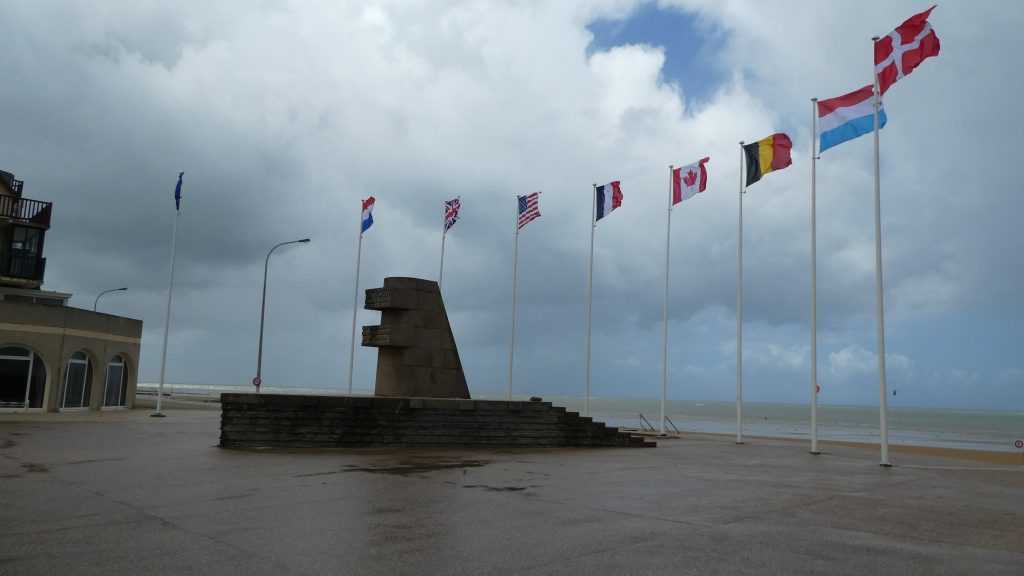
Juno Beach, June 6, 2017

On an early morning in June a few years back, my husband and I got up to catch a train from Paris to Caen, a town in the Normandy region of northern France. From there, we were to meet up with a tour bus that would take us to Juno Beach, one of the beaches invaded by allied forces on D-Day.

My father, a history buff who served in the RCAF during World War II, had mentioned D-Day many times to me when I was younger. But it took this visit to make the events of that day very real for me.

The Allied invasion of the north coast of France in 1944 included Juno, Utah, Omaha, Gold and Sword beaches, involving U.S., British and Canadian forces.

It just so happened that our little tour bus rolled into Juno Beach on the anniversary of D-Day, June 6th. The weather on our tour was apparently similar to the weather leading up to the invasion, with a lot of wind and rain showers.

The beach itself is huge, and the area includes several bunkers, tanks and monuments, along with the Juno Beach Centre, which is a museum and memorial. Along the beach you’ll also see Canada House, which was the first house to be liberated by allied troops on that day.

We stood at the bunkers imagining the terror and the pain that these young men must have endured, and we walked along the beach where so many of them lost their lives. We choked up as we stood and sang Oh Canada inside the Juno Beach Centre during a ceremony to mark the anniversary.

As the rain and wind kicked up on our walk past Canada House, we were invited inside. This was a rare experience, we were told. Tourists aren’t usually allowed inside, but they felt sorry for us because of the inclement weather.

The moment that really stood out for me, however, happened when we were returning to our tour bus at the end of the day. An older man who lived nearby walked up to us and asked us if we were Canadian. When we told him we were, indeed, he thanked us and our country for our part in D-Day.

And as we drove through the streets of Courseulles-sur-Mer up behind Juno Beach, we saw houses with little Canadian flags on their lawns to mark the occasion. The entire day was a profound experience for both my husband and I.

But I was floored recently when I read a story of how local French developers want to build 70 condos on this historic site. A “questionable” municipal land deal handed these developers a large piece of land right next to the Juno Beach Centre.

There has been plenty of local opposition to it, and two years’ worth of litigation, which has all been paid for by the Centre. But to no avail.

A website called savejunobeach.ca has been set up to encourage Canadians to write to our MPs and to donate to the Juno Beach Centre Association so that they can continue to fight for this historic site. As we all know, once development starts, it doesn’t stop.

It was through the hard work of veterans that the Juno Beach Centre was built in the first place, and it is solely supported by volunteers and donations. And now, as the website says, “The legacy that our veterans built for future generations may disappear entirely.”

We need these sacred places, if only to remind us of the past and what those generations before us sacrificed for us. While the world witnesses a brutal invasion by another mad man, the saying “those who cannot remember the past are condemned to repeat it” is more relevant than ever.

We have to save Juno Beach. Let we forget.