post

Put The Ballot In The Box, Eh?

I was in my early 20’s when someone I worked with convinced me to volunteer for a provincial party in an upcoming election. I had no idea what that really meant, but it sounded simple enough. Answer some phones, knock on a few doors.

So I went for it. A little bit of training as to how to approach people and what to say, and I was on my way.

I liked working in the campaign office, it was simple enough. The knocking on doors part was, well, a little more of an eye opener.

A lot of people weren’t home or didn’t answer, so I just pushed a leaflet through the mail slot. Easy. And of the ones who did answer the door, most were polite and at least took my leaflet.

But then there were the ones who had to, let’s just say “share” their ideas about the election and the candidates. There were a few who called me nasty names. And there were those who basically just slammed the door in my face. Yep, sometimes it’s rough out there for volunteers.

As I was growing up, whenever my my extended family got together for some occasion, the adult’s conversations would almost always centre around politics and current events. I can still hear the voices of my uncles rising and interjecting, not so much in anger, but maybe in small disagreement and definitely with passion.

One of my uncles ended up being an Associate Professor of Political Science at UBC, so it certainly ran in our blood.

That influence always encouraged me to vote, starting with the first election I was old enough to vote in. In my family there was nothing more important than filling out that ballot and stuffing it in the box. Even if you weren’t particularly inspired to do so, you just did it.

It almost feels like an understatement to say that this federal election has felt like no other in my lifetime. In our lifetimes. A couple of people I know have been volunteering for the first time ever. Here’s a toast to all of you election volunteers, by the way. You’re the best.

The advanced polls actually had line ups where I voted last Friday. I’ve never, ever seen that. There was a higher turnout for advanced voting than has ever been recorded in our country. That’s saying a lot.

Because of all of the unpredictable moves and threats from our neighbour to the south, suddenly Canada is united in a way that we’ve never experienced before. I see lots of people checking the labels in the grocery stores for Canadian products. Or Mexican or Italian. Anything but you-know-who.

“Elbows Up” t-shirts and “Proudly Made In Canada” signs are all over the place. The Canadian flag is flying everywhere while the American wine section in my local liquor store is proudly empty.

I’ve always felt the good fortune of being Canadian. Sure, we have our faults (sorry), and we don’t always agree. But that’s the whole point of being a democracy! We’re ALLOWED to disagree!

And, most importantly, we’re allowed to vote. Just imagine if we couldn’t do that.

There are a lot of other countries in the world rooting for us, supporting us, flying our flag. So on April 28th, as Canadians, all we have to do is one simple little thing: if you haven’t already done so, go and vote. Hop on this momentum and take it to the polls.

Because now, more than ever, it means everything.

Let’s put the ballot in the box, eh?

IJ
post

5 Years Post-COVID – What Have We Learned?

I don’t know about you, but anytime something bad has happened in my life — well, the good things too, but especially the bad things — I try to figure out if there’s something I can learn from it.

I suppose it’s in our DNA to make an attempt learn from the bad stuff so we don’t do THAT again.

Mistakes I make are one thing, but the things that happen TO me, I try to understand them and then let them go. I even succeed! Occasionally.

It’s hard to believe that we’ve recently passed the 5 year mark since the W.H.O. declared COVID a global pandemic. In some ways it feels like a very long time ago. And going through an event as major and earth shattering as a pandemic has taught us all something.

Okay, some of us anyway.

There was a lot of good that came out of the bad. To begin with, it was amazing how scientists came up with a vaccine for COVID. And even more amazing how quickly that vaccine was distributed to all of us so we could stop the spread.

Of course, it didn’t get to everyone soon enough and some paid the ultimate price. I, myself, knew of a couple of people who died from COVID.

The rest of us figured out how to adjust to a very different world. It wasn’t easy and it was definitely scary sometimes, but we did what we had to. Well, most of us.

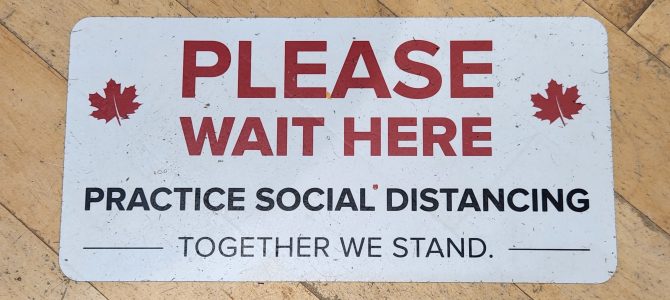
“Social distancing” became the phrase of the day. Wearing masks and standing far enough apart in public, or learning to use technology to meet online instead of doing so in person, became the thing. People started working from home, and some continue to do so to this day.

My husband had to go through a rigmorale to get his work computer hooked up in his home office. But once he did, he could more or less continue his work with just a few minor inconveniences.

I had to stop teaching guitar in person for a couple of months. I tried to teach online, but it was a lot more awkward, so I ended up taking a break instead. I was lucky that I could get away with that. And CERB helped.

A lot of people and businesses struggled, of course, and some have never fully recovered. We still see buildings and offices standing empty, even 5 years later.

Kids suffered a lot with having to get their school lessons at home and not being able to see their friends, or play at the park. For a child, those are BIG things.

And people in care facilities or confined to hospital suffered equally as much.

But we adjusted. We found ways to stay in touch without the touching part. We celebrated health care workers, really appreciating them for the first time. We put hearts in our windows and made a racket with our pots and pans every night when their shifts changed.

We stocked up on toilet paper. Yeah, that was kind of weird.

We learned the value of masks and disinfectant and washing your hands.

Oh, about the masks. Some people still haven’t figured out that wearing it under your nose doesn’t work. IT DOESN’T WORK.

Sorry, got off track there.

We came to value our families and our friendships so much more. Sitting together for a meal with an old friend. Going to a movie or a hockey game with the kids. So many things that we took for granted before.

And somehow we made it through. Especially when we found toilet paper.

These days we hardly ever see the word COVID in the news. Oh, it’s still around and probably always will be in some form or another. And there are some who are struggling with long COVID and who have had to adjust to a new physical norm. For them, COVID goes on and on.

Some stores or offices still have those old social distancing stickers, faded and worn, but a small reminder of our experience.

People wear masks more readily now than before the pandemic and I don’t blame them. We’ve become a lot more conscious of how easily disease and bacteria can spread. Been there, done that, don’t want to do it again.

In the end, an experience such as surviving a pandemic teaches us that we can overcome just about anything that threatens us. Anything. And ANYONE.

Yeah, you know who I’m talking about.

Now THERE’S someone who needs to be taught a lesson or two…

IJ

No News is Bad News

close up shot of keyboard buttons
Photo by Miguel Á. Padriñán on Pexels.com

The other week I got a message from my oldest daughter sadly mentioning the fire at Ricky’s All Day Grill here in Victoria, a restaurant we used to frequent every now and then when our girls were small. I immediately went to CHEK News’ website to find out about it.

What was curious to me was that my daughter knew about it before I did. I’m a news junkie myself and usually start my day reading the paper and perusing news websites.

So I asked her where she found out about it.

She told me that one of her coworkers saw the story on Facebook in a community called What The Hell Just Happened. Well, that was news to me.

It’s an interesting thing, where our adult children get their news and information these days.

When I was a kid (oh, here she goes!), there was radio and there was television. And, of course, there were newspapers. Radio would have more up-to-the-minute news, usually at the top of the hour. My parents always had the radio on.

My husband’s father was a radio announcer and a news director at various stations, so the radio was definitely always on in their house.

Typically, we would find our parents with their faces buried in the local paper every morning or evening, depending on when they had a chance to read it.

When our family got a television sometime in the 60’s, the news was something you watched at around 6pm every night. So as it turned out, you didn’t know about a lot of events that had happened in the rest of the world until that time.

And of course, during our parents’ youth, back from the 1920’s to the 40’s, sometimes it was weeks or months before they learned about what was going on somewhere else in the world.

Imagine that. Not knowing about a war or an earthquake somewhere far away until long after it had happened.

These days, we have tweets and videos immediately after, or right at the moment of something happening.

And as we have learned over the last few years, this leads to a lot of MIS-information. Sometimes it’s innocent, sometimes not.

This is exactly why we need to be able to trust who is giving us the information. Radio, television and newspaper reporters are trained to research the heck out of any information they pass on as news. Sometimes they get it wrong too, of course, but not for lack of trying.

Sadly, the trend these days appears to be fewer and fewer traditional sources, especially of local news. Smaller newspapers are shutting down everywhere, and television and radio stations are disappearing off their respective “dials”.

The recent news about the 1,300 positions being cut, and the selling or shuttering of 9 radio stations at Bell Media, is a shock. But then it’s not.

Business models are changing as the internet and social media are taking over. So the federal government has passed Bill C-18 in order to force companies like Meta and Google to pay for the news they allow and/or distribute on their platforms.

But now these very rich, mega companies are fighting back and threatening to block Canadian news from their websites. Heaven forbid they should share their gobs of money!

I mean, on the one hand, the advances in technology can be exciting. I read my paper digitally. I can even read the New York Times online because I have a library card from the Greater Victoria Public Library!

I can keep up with what’s happening by following local news accounts on social media. But I’ll watch it on TV too. Because I’m old. Make that “older”.

So is traditional news gathering on its way out? I sure hope not. Losing local news and dedicated, educated journalists and reporters is bad for all of us, young and old.

Which is why I’ll make a little adjustment to that age-old idiom.

No news is, in fact, “bad” news.