Why I Write

Cover of "Born to Run"
Cover of Born to Run

© I.Woloshen

This was a question posed to our newsgroup recently…some questions just get me thinking about the process or the motivation behind writing. I’ll tell you my story if you’ll tell me yours!…

Songwriting seemed to be a merging of two elements for me as a kid…the love of music and the desire to express something. I don’t think I made some conscious decision to be a “songwriter“, but it came quite naturally over a period of time. What it evolved into was a very conscious and thoughtful process of evaluating the events and the emotions of my life, always with an awareness of being able to effectively communicate them to someone else. Aren’t there times when we all have the desire to tell people how we feel? Don’t we all want to be listened to…REALLY listened to?

But there’s more to it than that for me. I’d say that over the many years I’ve been writing, I have “given it up” seriously maybe a half a dozen times. And what I’ve discovered is that I can’t NOT write…it is, as Mary Chapin Carpenter has expressed, the only way for me to make sense of the world around me. And if I don’t have that, then life becomes chaotic again…non-sensical, and difficult to deal with. Writing, for me, is as second nature as all of the basics.

I’ve recently had a serious personal upheaval that has built up over a couple of years…through every stage of it, I have had my writing, and when I look back at the many events I have experienced, both positive and negative, my writing has had an integral part in my ability to understand it. I’ve never had a therapist, even though I’ve had to face addictions and depression. Part of that, I think, is because songwriting becomes my therapist.

This all sounds like a self-centred meandering…but I’ve noticed something else more recently. I have a very accute desire to “entertain”, and many of my songs have taken on that aspect in the last few years, either through humour or “personality”. But songwriting is like that…if you stick with it long enough, it evolves in many ways. Of course, I’m also a performer, so I have this great advantage of being able to act out the song with my face and body…and sometimes I forget where I end and the song begins.

There was a time when I was much younger (!), when I had the idea in my head that unless a songwriter was just expressing a “pure” state of mind, it wasn’t sincere. I never question anyone’s reason for songwriting now, because I know that it comes from many places. There is no need in judging another songwriter’s motives…I wish them success no matter what those motives are. I would like to know what yours are…why do you write? What is your ultimate goal when it comes to your songwriting?

Here’s what Michael Barrett had to say:

“I just thought I’d give a little insight into why I started off songwriting. When I was about 6 (I’m 16 now), a little rhyme came into my head. The rhyme is very daft and I’m not going to print it here unless someone asks me to. Anyway, I forgot about it and pushed writing out of my head. Until I was 12, when I found an old Bruce Springsteen CD of my fathers. At first I only listened to track 1 (Born To Run), but then widened my knowledge by playing the whole CD, and eventuall became a big fan. I also started listening to Bob Dylan, Bob Seger-all the ‘oldies’ as they call them. One day I turned on the radio and it was tuned to Longwave 252-people in England may recognise it as the popular music station. They were playing dance music. I thought ‘eww'(never really liked that hip-hop stuff) and tuned it to BBC Radio 2 (because there was a Bruce Springsteen interview on).

“Eventually I heard a song by a band called Stardust, called ‘Music Sound Better With You’. As soon as the first few bars had been done, I knew I didn’t like it. But I kept on listening to the end. I thought ‘gee I bet that song doesn’t do well’. Then I discovered that it was on almost EVERY dance album. I mean, the song was so dead-the ryhtm had no alterations for chorus or bridge (because there was none), the only lyrics were ‘hey baby music sounds better with you’, I could carry on all night…..Sure there are quite a few good bands out there but this one song REALLY got on my nerves-I’ve even been known to leave shops and cafes when it comes on- so I decided to do something about it and immerse myself in rock, blues, folk. Then I started writing poetry, I can remember the first one I wrote was about Rememberence Day, still got it lying around somewhere. Then I picked up my first guitar and immediately fell in love with it. I began finding things out about myself through the passion I could evoke by certain chords, strumming patterns, slow or fast tempos, soft or hard strums. Soon I found myself thinking ‘wouldn’t it be good if I could bind poetry and music’, and I did-my first song was devoid of chorus, bridge, just 6 lines per verse, and a pretty simple chord pattern-as first songs usually are, this was just my way to cut my teeth in the methods. I found myself thinking deeper and deeper, writing for other people, and mostly myself (the reason why most of my songs are about love and rejection). I was hooked, felt as if I was delving into what I really am and finally actually enjoying the fellings I have, whether negative or positive.

“So going back to your main question, why did I start songwriting? Many reasons:

-So I could get profit (although this one faded eventually)
-So I could be like my heroes (to this day I want to meet Springsteen)
-To seperate myself from the masses
-To try to forget about Stardust

But I believe that my main reason, and maybe many other’s reason, is TO DISCOVER YOUR TRUE SELF.”

So what’s your motive, what made you begin this wonderful craft? If you’d like to express yourself about it, why not try my songwriting messageboard, sign up and participate!

Reblog this post [with Zemanta]

Meaning and Metaphor

© I.Woloshen

Recently, someone in rec.music.makers.songwriting posted a question as to why many of the songwriters in the group didn’t seem to make much use of metaphors in their lyrics. Actually, I’ve seen them used quite a bit…but I do think that some writers are intimidated (even by the word!) and don’t know how beautifully it can paint a picture if used well. I’ll try to give some examples as I go, but first I’ll give you the definition if you’re not quite sure what a metaphor is:

In the Webster’s Dictionary, “metaphor” is defined as: “Transference of a term to something it does not literally apply to…”. Probably the most familiar setting of a metaphor would be with the words “like a” as in “I ran like a bat out of hell”. Someone recently pointed out to me that this is more accurately called a “simile” which is defined as “comparison, especially in poetry”. To insert “like a” does technically make a difference in how you define the term, however, the idea is the same. Here’s a line from a Shawn Colvin song called “Steady On” on her album of the same name…

‘I am weaving
Like a drunkard
Like a balloon up in the air
I am needing a puncture
And someone to point me somewhere’

What’s nice about these similes is that she carries the image through to the rest of this verse…you can really let your head go off in some interesting directions lyrically when you get a vision of something you’re trying to describe. The fact that she’s weaving like a drunkard could imply that she’s admiting to irresponsibility or being out of control…the “puncture” line seems to imply that she really needs a dose of reality. The interesting thing about similes and metaphors is that although they may be trying to evoke something specific, they can, in fact, take the listener on a very personal trip. I’ve found many times that people have interpreted my songs in their own way. I like the idea of someone being able to put their own stamp on something I’m expressing. You can’t really be too inspired with lines like “You broke my heart” after you’ve experienced some truly fascinating lyric-writing. Here’s an example in an early Joni Mitchell song called “You Turn Me On (I’m A Radio)”(definitely a metaphor!!):

‘Oh honey you turn me on, I’m a radio
I’m a country station, I’m a little bit corny
I’m a wildwood flower waving for you
I’m a broadcasting tower waving for you’

Here she personifies what she is describing…I can only imagine her getting into the visuals of some small Saskatchewan town (in the Canadian prairies where she grew up) pulling out and playing with all of these images. This is only one of many, many examples of Joni’s craftiness and creative use of imagery. She has the uncanny knack of stuffing a novel full of images all in one line. Everytime I go back and listen to a song of hers I’ve heard many times, I find some new dimension to it, a new meaning.

Which brings me to the “meaning” part of songwriting. Cliché’s are one thing, but over-used phrases as the “You broke my heart” line above, really don’t have any life of their own. They don’t evoke emotion, which is a very powerful tool for a songwriter. How can you bring your song to life, and give it deeper meaning? One way is to listen to examples of others who have a knack in this area. Another is to try free-association when you’re writing. Don’t worry about the meter or anything else, take the line and sit down and come up with as many images you can around it. For example, Joni’s trick of being a “wildflower waving for you”…the wildflower waving is a great visual, and the fact that it’s waving “for you” and not “at you”, gives it a supportive, positive feel. All that in one little phrase!

In a song I wrote (uh-oh, she’s getting desperate now!) called “Fusion & Fire”, I had alot of fun playing with metaphors using the universe (literally) and planets as a theme for long-lasting love. I also used Joni’s trick of personification in that one. Mary-Chapin Carpenter wrote a brilliant song called “This Shirt”…in it she basically used the shirt as a time-reference for a love affair, where it travelled, how it was used as a pillow, the sleeve rolled up with a pack of cigarettes, how she wears it now when she’s doing the housework…from a stinky old shirt, you get so much! Here’s a bridge from a Shawn Colvin song called “Set The Prairie On Fire” from her “Fat City” album. This bridge gets to me everytime I hear it…it just screams passion:

‘In the cool dusk of horses
Through the rusted wires of sleep
With our arms around midnight
We’re headed for release
We go riding in the wind
We go riding in the dark
Riding, riding…oooh’

Now, don’t you wish you could fire up those kinds of images? Don’t ever compare yourself with others, that’s a waste of time because you are unique. But DO admire others clever crafting, reading or listening to it could put you in exactly the space you need to be more creative with your own writing. And try a metaphor today!

Reblog this post [with Zemanta]

Song Structure

"This Old Guitar"
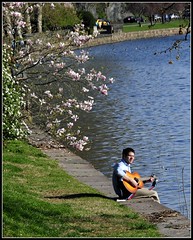
Image by Tony the Misfit via Flickr

© I.Woloshen

Often I come across songwriters who are confused as to the labels we have for different parts of a song. Verses and choruses are obvious, I think! However, what is a bridge? A pre-chorus? Intro? Extro? Here are my definitions (I’m smart enough to know that definitions can change from writer to writer!):

A bridge is a musical and/or lyrical break in the song, often inserted after a couple of verses and choruses. It can, when written effectively, give a little change of pace to the song once the repetition begins to become obvious to the listener. Sometimes I might write a simple musical break with no lyrics, usually in the same key, but with a different chord progression. Lyrics are often part of a bridge, however. I’ve also met pro songwriters who HATE bridges and never write ’em! To each his own!

A pre-chorus is a lead up to the chorus, a kind of “build” if you will. They are not as common as bridges, but can be very effective in bridging the verse just before the chorus.

Intros are at the very beginning of a song, the introduction to it. If you are pitching your songs, better keep your intros SHORT!! Publishers, A&R reps and label execs usually don’t have the patience for long self-indulgent intros, and may give up before you even get to the first verse! Sometimes an intro can be effective by foreshadowing the chorus chords just a little, or a quick build of instruments into the song. When I’m playing live, I may stretch the intro to a song and let it build a groove before I start singing.

Extros are often mis-labeled “outros” (I hate that!)…and are the lead-outs or endings to a song. Again, they can get too long and self-indulgent. The faders on recording equipment back in the sixties and seventies lead to just about every recorded song fading out…! There’s nothing that beats a nice, tight and unexpected ending, though!

Middle Eight – this is a term you might hear that sometimes refers to a type of bridge, and other times is simply an instrumental break, usually (but not always) eight bars long. In a rock song, for instance, it might contain a guitar lead…Eddie Van Halen howling alone on his guitar for eight bars 🙂

Breakdown – sometimes about two-thirds of the way through a song, you’ll suddenly hear just the drums playing alone, or the vocals alone, or hand-clapping, etc., with nothing else in the mix. Then, there will be a build-up of instruments again. This is what is referred to as a “breakdown”. It’s more of an arragement term, rather than a songwriting one. But if you’re in a studio trying to get a good recording of your song, you might use this trick to make your arrangement more interesting.

And here’s my extro…. 🙂

Reblog this post [with Zemanta]

Attitude is Everything

Songwriter Session at the Bluebird Cafe: Jamie...
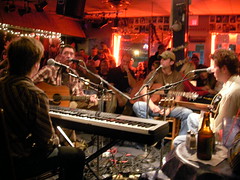
Image by TedRheingold via Flickr, Bluebird Cafe

Even though we songwriters tend to seclude ourselves sometimes when we’re trying to come up with another tune, there does exist a community of songwriters out there. It includes professionals and amateurs, young and old, rock, country, and all of the other genres, and male and female. Each has unique perceptions and experiences to bring to their craft; each is driven by a desire to express and create something.
What I find most interesting is the attitudes expressed and how those attitudes can completely colour my response to a songwriter‘s material. Recently I remember reading a post in the newsgroup rec.music.makers.songwriting from a songwriter who began to list the subject matter that he thought “sucked” in songs. He included any songs you write in the first person, love songs, any kind of relationship songs, and the list went on and on. I was immediately aroused from my complacency, since I most often write about those very topics! It made me think about what it is in a song that appeals to me and what doesn’t, which is a completely relative experience, but I responded with a post saying that it isn’t the subject that “sucks”, but the way in which that subject is handled. What interested me even more was how this person had essentially dismissed the majority of songs and songwriters out there with his attitude. Occasionally the “dark” side of creative immaturity and competitivenss rears its ugly head and reminds me of where I came from.

We’ve all been there. That “I can write better songs than that” string of thought that temporarily boosts our egos when we hear someone else’s material that doesn’t live up to our expectations. It’s too easy to fall into that frame of mind when we’ve had to struggle with our own writing and the self-esteem gauge has dropped below zero. I’ve been to demo critiques in which the “experts” literally devastated the songwriters who were there, and others where the complete opposite has happened.

It’s a tough world sometimes, but the people I’ve admired most are those writers who seem to roll with every punch and have enough energy left to encourage and help others. And the conclusion that I’ve come to, the thought that has helped me more than anything else, is that THERE’S ROOM FOR EVERYBODY! We won’t all make a fortune from writing, or have great recognition, but the talent that exists is extraordinary! Sure, songwriters in the “business” have to compete with others to a certain degree, but it can be done with such graciousness. I’ve heard staff writers talk about sharing writing credits with a person in the room at the time a song was written because that person came up with one line or one phrase. That’s the kind of generosity and maturity we all need to emulate. Time and experience will teach us that, when it comes to the big picture, having written the best or worst song in our lives doesn’t really amount to much, that the value is in the process and in the community we build with each other. You can’t help but be lifted up when you lift somebody else up. These days, instead of trying to figure out what makes a song “suck”, I try to understand what makes it great…if I don’t like a song, rather than getting comparative, I move on to the next one…I take a step back from my ego every now and then and appreciate the process. Songs don’t “suck”…bad attitudes do!

Enhanced by Zemanta

The Music

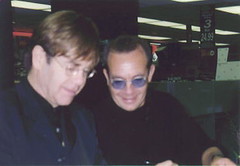
Elton John & Bernie Taupin
Image by Burns! via Flickr

I recently had e-mail from a new, young (14!) songwriter who wanted to know how to come up with the music for her lyrics. Since I usually come from the opposite direction (i.e. I usually come up with music first), it made me think about approaching it from the lyrics first perspective. I sat down and wrote out some lyrics off the top of my head and then realized that I definitely had a rhythm going while I was doing it. Not necessarily a melody, but since I usually write to an established meter with the music already created, I think this brought out my instinct to automatically meter the words.

The difficulty was in developing a melody to them. Elton John is someone who has always taken that role, receiving the lyrics from Bernie Taupin and putting a melody to them. In an interview I saw with him, he discussed how he first reads through the words to get a feel for the “mood” of the song. Sometimes he will change things around (I guess Bernie gives him some artistic license!), making a verse into a chorus or the other way around, adding or changing lines slightly to accomodate what comes to him musically.

Don’t be afraid to let the melody do the “talking”…if the melody starts to write itself a little differently compared to the lyrics, go with it. I heard once that a sculptor looks at the work as already existing within the material…his/her only job is to remove the unwanted stuff. I think you can remove or add lyrics or adjust your meter to make it fit the music and still remain true to the essence of the song.

How to come up with a melody? I once had to write the music to a whole bunch of poems in the play “Through The Looking Glass” (realizing much later that this had already been done professionally!) in high school. This was quite a challenge for me and I worked up quite a sweat doing it! Instead of trying to come up with chords, I “sang” the words…I just repeated them and sung a melody off the top of my head until it developed into something tangible. Then I sat down with the guitar until the chord “sounds” in my head matched the melody. It took alot of patience (when doesn’t it?), and it gave me a whole new outlook into songwriting! Needless to say, I went back to songwriting in my usual way!

Recently a student came to me with a melody she had in her head, but she wasn’t good enough at playing the guitar to play what she “heard” chord-wise. She hummed and I tried all the chords I could come up with and it was pretty frustrating! In the end we still didn’t find it, but she learned more about how to experiment on the guitar until she could come up with it herself!

Coming up with a melody first is my “specialty”. I usually do this by sitting down and experimenting with chord progressions, but sometimes I’m in the strangest places when the thing hits me! Baths are great, so is a walk on a beach for me. Driving the car with no radio or tapedeck playing is good too. What also works for me is learning a new song by someone else…lately Shawn Colvin‘s “Sunny Came Home” has been a source of inspiration…the rhythm of her writing is really catchy and the progressions in that song are terrific. I don’t copy it, of course! But when I learn something new, it often brings out something new because the mood of it can inspire. Or I play it wrong and come up with something else!

There are many schools of thought in terms of writing…my writing is very instinctive and never comes from a “well, this is a ‘C’ so I should be using an ‘Am’ ” attitude. But I have come across a number of songwriters who do exactly that…they come from the theory end of it. In fact alot of serious songwriters study the theory end of music quite voraciously, looking for a clue to writing a ‘hit’. There are all kinds of theories about hit songwriting. For me, I focus first on coming up with something that pleases my ear, and then I worry about whether or not anyone else will like it! Que sera, sera!

Enhanced by Zemanta