Songwriting Without An Instrument

Recently someone commented on one of my blogs that they would like to know how to write a song without an instrument.  You would think that because there is music involved, it would be next to impossible to write a song without any musical “ability”. If you are overwhelmed with the idea of learning an instrument, the fact is that many of us assume that we are supposed to become some kind of virtuoso on it which, as a guitar teacher, I can tell you is not true! Most guitar teachers can tell you that.

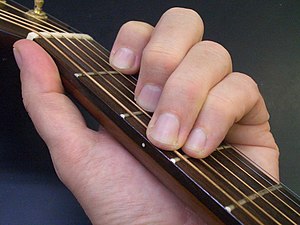
The Cmaj chord in guitar, with bass in G
Image via Wikipedia

Even if we are not singers, we can all hum.  And if you’ve been around music all of your life, as most of us have, you’ve probably found yourself humming along or singing along with your favourite songs.  If you already have some lyrics written, free yourself from your musical inhibitions by “singing” them in some sort of way that gives you a feel for the meter (rhythm) of them.  Don’t worry whether or not it is GOOD, just do it!  See if you can’t find some kind of melody that matches the meter and then just keep experimenting.  You might find that you “hear” certain melodies with certain lines and not with others.  That could mean that you just haven’t found it yet, or it could mean that the lines with no melodies just aren’t working.  So keep working at it, change the lines or mess around with another melody…just keep trying.  The more you liberate yourself from feeling like you CAN’T do it, the less inhibited you will become.

If you are overwhelmed with the idea of learning an instrument, the fact is that many of us assume that we are supposed to become some kind of virtuoso on it which, as a guitar teacher, I can tell you is not true!  Most people learn an adequate number of chords within a few weeks or months, for instance, to be able to play a good selection of songs that they like.  The fact is that many songs are rather simple in their chord progressions (a chord progression is a series of chords), and so they can be learned fairly easily.  So you can probably learn enough chords in a couple of months to start trying to match them to your lyrics.


As a songwriter, you don’t have to be a master of an instrument to adequately come up with some chords to your song.  So what I am advocating first is that you could pick up a guitar or sit at a piano and fool around with it by ear so that you can familiarize yourself with finding little melodies on it.  It doesn’t have to be a massive undertaking, just a simple way of getting to know the instrument so that you can feel comfortable with it.  Then if you feel ready, you can find some resources to show you how to play some simple chords, and then take it from there.

Your other option is to find someone who CAN play, and who can help you find chords and melodies.  This might take some doing, but then again, there could be someone in your own backyard or circle of friends who already plays and might be willing to experiment with your lyrics.  You can either give the lyrics entirely up to them, or you can sit with them and try to come up with some ideas together.

A third option would be to invest in some kind of software like Band-In-A-Box which is a clever computer software program that you can create backing tracks (music) to your melodies or lyrics with little effort.  You can play with chords without knowing which chords go together, and you can pick styles and instruments, again, without knowing much about them, and still come up with a decent sounding “band” to sing your songs along with.

I was at a songwriting retreat once where one of the participants in my little group didn’t play an instrument at all.  Somehow she had found someone to come up with chords to her melodies, so when it was her turn to perform one of her songs, she just gave the chords to someone who could play guitar and she sang along with him.  I admired her for her dedication to songwriting even though she had never learned an instrument.  And you don’t have to be limited either!

Now I know that some of you out there reading this blog might have suggestions of your own, so if you do, please add them below!  Comments and replies always welcome :-).

IJ

Enhanced by Zemanta

When It’s Time To Record Your Song


There are a number of things to consider when you decide that your song is ready to be recorded.  As a songwriter, you want the best representation of your song;  a recording that makes it stand out without creating too many distractions or losing focus.

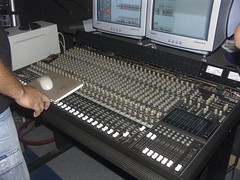
The studio board.
Image by baldguitars via Flickr

Before you make the decision to record a song, make sure it is in its final draft! I know it sounds obvious, but some songwriters are too quick to rush into a studio because they’re all excited about a new song. Does it stand up to the test of time? Have others who can give you some valuable feedback listened to it yet? If you’re a performer, have you performed it in front of an audience? Don’t rush the recording part!

If you have your own recording setup, you’ll recognize some of the terms I’m going to use in this article.  However, I’ll explain or define them as I go for those of you who are new to the idea of recording. First of all, I wrote an article quite awhile ago on the recording process for beginners which you can find here, but that has more to do with the technical aspect of recording.  If you are just about to go into the studio to record a demo, for example, you might want to think about what you want before you get there.

1. Intro Too Long – I can’t even count how many songs I’ve heard recorded by songwriters in their studios or as a demo that take FOREVER to get to the first verse!  Don’t make the mistake of creating an intro that’s so long it’ll make the publisher hit the eject button!  In fact, if you can manage to, don’t have one at all!


2. Do you need an instrumental break? –  If you are pitching a song, a wailing guitar solo is unnecessary and may actually detract from the song itself.  If you are a band, then by all means, put in the wailing guitar solo.  Think about who is going to hear this recording and what will be important to them.

3. Out of Tune – this is something I mention in the recording article too…you’d think it would be obvious, but make sure that your instruments are in tune before you record!  AutoTune (a handy little software device that corrects pitch) can do some magic, but often it can distort the sound of the instrument (including your vocal!), so don’t rely on that.

4.  Leave A Little Room for Arrangements – As a solo performing songwriter, my instrument ended up being the whole band.  Over the years I got better at playing my guitar so that it became the percussion (if necessary), the bass, and everything else I needed to fill the musical “space” when I was performing.  But when I would go into the studio, I’d have to learn to play it less or simplify it so there was room for the other instruments!  You may not be recording your instrument at all because maybe you prefer to leave it to more professional musicians.  But if if ARE, you have to think of your instrument differently when you get into the studio.  Let the bass player do the bass runs, let the drummer drive the rhythm, and unless you are an amazing instrumentalist and it is truly a part of your “sound”, let your instrument be present without being too dominant.  You might consider spending some time with the other musicians ahead of time, if possible, to work out how everything is going to go together.

5.  Keep It Tight – another problem I often hear in demos is when instruments and drums are too loose.  You don’t want to over-quantize (another handy little software device that adjusts the timing of especially midi instruments), because then it won’t feel “real”, but you do want to find the pocket.  I love that word, “pocket”.  I heard Quincy Jones use it in reference to having all of the instruments hit the right note at the right time with just the right velocity (volume) and feel.  Not easy to do, but worth the effort!  One note to think about:  let the drummer drive the rhythm.  When people are recording instruments especially, they try to anticipate the beat of the drummer, and often play just the slightest bit too soon.  Then the song feels off kilter and too loose.  Practice with a metronome or a click track.  Just Google “metronome” and you can find them online.  When you’re working with one, let the click pull your rhythm…it takes a little work but it will improve your timing immensely.

6. K.I.S.S. – when in doubt, less is more.  Don’t try to stuff too many instruments and bits and pieces in there…it’s about the SONG.

7. Lyrics Up Front – It’s about the SONG.  Don’t bury the lead vocal in behind a whomping bass and crashing cymbals and wailing guitar.  You want them to hear the lyrics, right?

8. When You Invite Friends To Play – of course, we all like the idea of having people we know play on our recordings.  But recording isn’t like jamming, it can be very repetitive in terms of getting just the right sound and licks, fills, etc., and then repeating that until everything fits just right.  It can start to feel a little mechanical after awhile.  I once had a guitar player (not a friend, by the way!) come in to do some lead work on a recording.  He had several guitars, lots of effects and certainly had some talent.  But he could not repeat something he had done before or even remember what he had done!  He really was only good at jamming.  In the end I managed to catch a few bits that I could use, but it wasn’t very helpful in terms of adding some real texture to the recording.

Most of these apply, more or less, to a situation where you are singing and/or playing on the recording.  However, some of you are not singers and would rather have someone else do the demo.  There are plenty of demo services around, even online, where you can send a rough recording of the song and have them do it.  It’s important to educate yourself enough so that you can ask for what you want.  If you “hear” things, like instruments playing in particular parts, or you want a certain sound or feel (soft, energetic, etc.) then you have to communicate that to the people recording your demo. You might be too intimidated by the process and just want to give it over without any input, however you might not get what you expect in the end.  Whoever is doing your demo will, and should, ask you lots of questions first in order to establish what will be needed.  Here are some other tips:

1.  Ask – for a demo or sampling of their recordings before you hire them, so you can assess whether or not they can do what you want.  Make sure they are comfortable in the genre your song is in.

2. Trust Your Gut –  If you’re not comfortable with the person you’re communicating with, then go elsewhere.  It’s important to feel that you can say what you want, even if you don’t exactly know how to say it!

3. Educate Yourself – as I said before, the more you know about the process, the more confidently you can ask for what you want.  If you don’t understand something, ask.  There are lots of places on the internet  where you can research what happens in a studio and the terminology that is used.

4. Everything Up Front – most studios will offer you a package deal, one price that covers everything that you want included.  If you want some changes after the fact, you’ll have to negotiate that, but don’t let them nickel and dime you.  Be sure that it’s clear what you are going to get for your money before you proceed with anything.

It’s exciting to hear your song recorded properly for the first time. If you take the time to consider everything I’ve mentioned above, there won’t be any unpleasant surprises and you’re ready for the next step…putting it “out there” for the rest of the world to hear :-).
Reblog this post [with Zemanta]

Nothing To Write About?


In another article called Songwriting Topics I went through a myriad of things you can do to inspire yourself in terms of what to write about (what?  you don’t have anything to write about? :-)), and most of them were the obvious such as using your own life experiences or those of others.

Cliffs of Moher – Edge of the World
Image by janusz l via Flickr

But what if you are bone dry in terms of ideas?  Where else can you get them?

I’ll focus on a few places on the web that might help you get some ideas.  In fact, you might learn to get really creative about being creative!  The web is an excellent way to get ideas if you know how to use it and what’s out there.


Interestingly enough, as I’m writing this blog I’m looking at something called Zemanta.  Zemanta is essentially a media and article/information gallery that you can use as a plugin in Firefox or in a WordPress blog like I have.   You can try it out on the demo page on their website.  Type anything in the text box and Zemanta will come up with images, articles, links and tags relating to whatever you’ve typed.  It’s a pretty clever little tool.

Which brings me to another idea.  Pictures can be really inspirational sometimes, especially photographs.  If you go to a website like Photography.com, you can browse through hundreds of stock photos;  pick a subject like flowers or landscapes and see what you can come up with.  I often peruse a website called BOOOOOOOM! which has photography, but also art and sometimes even videos, all in blog form.  It’s a very cool site to look through even if you’re not looking for something to write about :-).

Okay, but what if you’re looking for musical inspiration?  Aside from listening to other songs, where else can you get some musical ideas?

A few months back I found a really neat little site called Jam Studio where you can literally create a whole music bed right on the site.  It leads you through entering some chords and picking some instruments, including drums, bass, guitar and piano and even a “feel” or genre like country or rock.  Then voila!  You can create a whole song in any key and come up with all kinds of ideas!  Try it out.

And last, but not least, I wrote an article for the Muse’s Muse awhile back where I featured an NPR series called “Project Song“.  The whole idea is that an artist or band is given a set of photos and words to choose from, and is given two days in a studio to come up with a song representing them.  It is a very interesting premise and on the Project Song website you can watch a video showing how songwriter Nellie McKay came up with her song “Cavendish” using the tools at hand.

You might do the same for yourself…take a random photo from one of the websites I recommended and go to a dictionary and pick out a word or two and see what you can come up with!

In fact, I’m thinking of coming up with a songwriting challenge to do exactly that.  Keep your eye on this blog in the coming weeks…!

IJ

Reblog this post [with Zemanta]

Don’t Digg Baloney


As part of my research for writing this blog, writing my column for the Muse’s Muse and Twittering about songwriting tips, I tend to spend a lot of time online looking at other songwriting websites and blogs.

Digg, Inc.
Image via Wikipedia

What I’ve noticed is that people mean well, but sometimes they are giving incorrect information or selling something as a “how to” write something, when it is clearly just “my way”.  It’s hard for a beginner songwriter especially to know what is true and what is simply someone’s opinion.

For instance, I read a blog just recently that stated that in a chorus, you must have two distinct phrases and then they should repeat.  The blogger also stated that you should also have the hook in the chorus.  Well, the truth is that this is not always the case!  You could simply go through a list of your favourite songs and find that most don’t follow these so-called “rules”.  Now this person is probably just trying to be helpful, but it would have been better for him to say:  “this is one way you might write a chorus”.  And that would be helpful!  And where did I find this tip for writing “better” songs?  On Digg.com.  That means that people are reading these blogs and deciding that they are important enough to digg them and pass them on to others.

Please do not take ANYONE’s tips (not even mine!) as gospel.  They should simply be thought of as one approach to your songwriting.  You should always be suspicious of someone who tells you “THIS is how you write a song.”  The internet is full of information, but you have to decide for yourself if the information is valid or simply someone’s idea of the truth.


Research.  Some will make statements that simply aren’t true, or use incorrect terminology or musical references.  There are legitimate sources for information on musical terms and music theory, for instance.  Find out what they are and double check when you’re not sure of something.

More is better.  If you see the same tip in more than one place, it’s probably because it’s a good tip.

Trust your gut.  If something doesn’t seem right to you, ignore it.  If it seems ridiculous, it probably is.

Everybody thinks they can tell you how to write a song.  Listen to their work if they have any online before you decide if they are worth paying attention to.  Check their references.  When they claim that they can guarantee you’ll write a hit, email and ask them to list their hits!  You can go to websites like BMI and ASCAP and check their names.  Have they even REGISTERED a song, let alone written a hit?

And last, but certainly not least, do not give money to someone before you have thoroughly researched their legitimacy.  I had a guy who sent me a letter from Nashville EVERY YEAR for 10 years, telling me how he was going to get my song (which he would incorrectly name every time!) to top artists in Nashville for the measly sum of several hundred dollars.  I laughed and dumped it in the recycling box every year.  I’m nobody.  Why would he want my song so badly?  Because he didn’t!  He wanted my MONEY so badly :-).

Reblog this post [with Zemanta]

The Bridge – Somewhere Between Here and There

There are plenty of songs out there without a bridge that survive quite well, thank you very much.  However, let’s look at this special part of the song form and get an idea of how to make the best use of it in your songwriting.

First of all we need to identify what a bridge actually is, and one of the best ways to do that is by pointing out some more “famous” bridges in popular songs.  Think about the song from The Wizard of Oz called “If I Only Had a Brain”.

Dorothy and Friends
Dorothy and Friends (Photo credit: drurydrama (Len Radin))

I could wile away the hours
Conferring with the flowers
Consulting with the rain
And my head I’d be scratchin’
While my thoughts were busy hatchin’
If I only had a brain

There are three couplets or rhymes in the verses:  hours/flowers, scratchin’/hatchin’ and rain/brain, and six lines in the verses, with shorter, more punctuated notes.

In the bridge, the notes are longer and the chord structure changes, even including a slight modulation or key change before going back to the original key:

Oh I-I-I could tell you why-y-y-y
The ocean’s near the sho-o-o-re
I could think of things I’d never thunk befo-o-ore
And then I’d stop and think some mo-o-ore

Although not as significant in this particular song, quite often the bridge creates a whole different perspective or “step back” from the rest of the song.

Let’s take a look at a more contemporary song;  Sheryl Crow‘s “My Favourite Mistake“.

This is a typical “break up” song:

I woke up and called this morning
The tone of your voice was a warning
That you don’t care for me anymore

Most of the verses detail the events that are taking place, the singer pointing out the evidence of an impending break up.  The bridge, in contrast, is more philosophical.

Well maybe nothing lasts forever
Even when you stay together
I don’t need forever after
But it’s your laughter won’t let me go
So I’m holding on this way

In this particular bridge, not only is it quite distinctive musically, but it’s a great example of how the lyrics take a step back and give a over all view of the rest of the song.  However, bridges don’t have to have lyrics either.  Sometimes a musical bridge that takes off in a new direction has the same effect as a lyrical bridge.  One example of a music-only bridge is in Coldplay‘s song “Viva La Vida“.  It changes chord progressions and then the only vocal you hear is “oh, oh, oh, oh, oh”.  (Well, they’re NOT lyrics :-)).  Then it comes back to the last chorus.  And the famous song “Dust In The Wind” has a musical bridge featuring a string section!

So the main purpose of a bridge is to provide musical and lyrical contrast, and sometimes to set things up lyrically for the end of the song.

Years ago I took a weekend songwriting workshop through The Songwriter’s Association of Canada where one of the workshop leaders, a songwriter who had had success on his own and with a band, said he hated bridges and didn’t see the point of using them.  Many songs do just fine by having a middle-eight or musical break using the same chord progression as the verses or chorus. And while many famous bands and artists over the years have only rarely used bridges in their songwriting, I think they can be quite effective in the right song.

If your song is feeling a little repetitive after a couple of verse and choruses, try to experiment with a change in chord progressions and lyrics (if you like!) and see if you can come up with your own bridge.