Meaning and Metaphor

© I.Woloshen

Recently, someone in rec.music.makers.songwriting posted a question as to why many of the songwriters in the group didn’t seem to make much use of metaphors in their lyrics. Actually, I’ve seen them used quite a bit…but I do think that some writers are intimidated (even by the word!) and don’t know how beautifully it can paint a picture if used well. I’ll try to give some examples as I go, but first I’ll give you the definition if you’re not quite sure what a metaphor is:

In the Webster’s Dictionary, “metaphor” is defined as: “Transference of a term to something it does not literally apply to…”. Probably the most familiar setting of a metaphor would be with the words “like a” as in “I ran like a bat out of hell”. Someone recently pointed out to me that this is more accurately called a “simile” which is defined as “comparison, especially in poetry”. To insert “like a” does technically make a difference in how you define the term, however, the idea is the same. Here’s a line from a Shawn Colvin song called “Steady On” on her album of the same name…

‘I am weaving
Like a drunkard
Like a balloon up in the air
I am needing a puncture
And someone to point me somewhere’

What’s nice about these similes is that she carries the image through to the rest of this verse…you can really let your head go off in some interesting directions lyrically when you get a vision of something you’re trying to describe. The fact that she’s weaving like a drunkard could imply that she’s admiting to irresponsibility or being out of control…the “puncture” line seems to imply that she really needs a dose of reality. The interesting thing about similes and metaphors is that although they may be trying to evoke something specific, they can, in fact, take the listener on a very personal trip. I’ve found many times that people have interpreted my songs in their own way. I like the idea of someone being able to put their own stamp on something I’m expressing. You can’t really be too inspired with lines like “You broke my heart” after you’ve experienced some truly fascinating lyric-writing. Here’s an example in an early Joni Mitchell song called “You Turn Me On (I’m A Radio)”(definitely a metaphor!!):

‘Oh honey you turn me on, I’m a radio
I’m a country station, I’m a little bit corny
I’m a wildwood flower waving for you
I’m a broadcasting tower waving for you’

Here she personifies what she is describing…I can only imagine her getting into the visuals of some small Saskatchewan town (in the Canadian prairies where she grew up) pulling out and playing with all of these images. This is only one of many, many examples of Joni’s craftiness and creative use of imagery. She has the uncanny knack of stuffing a novel full of images all in one line. Everytime I go back and listen to a song of hers I’ve heard many times, I find some new dimension to it, a new meaning.

Which brings me to the “meaning” part of songwriting. Cliché’s are one thing, but over-used phrases as the “You broke my heart” line above, really don’t have any life of their own. They don’t evoke emotion, which is a very powerful tool for a songwriter. How can you bring your song to life, and give it deeper meaning? One way is to listen to examples of others who have a knack in this area. Another is to try free-association when you’re writing. Don’t worry about the meter or anything else, take the line and sit down and come up with as many images you can around it. For example, Joni’s trick of being a “wildflower waving for you”…the wildflower waving is a great visual, and the fact that it’s waving “for you” and not “at you”, gives it a supportive, positive feel. All that in one little phrase!

In a song I wrote (uh-oh, she’s getting desperate now!) called “Fusion & Fire”, I had alot of fun playing with metaphors using the universe (literally) and planets as a theme for long-lasting love. I also used Joni’s trick of personification in that one. Mary-Chapin Carpenter wrote a brilliant song called “This Shirt”…in it she basically used the shirt as a time-reference for a love affair, where it travelled, how it was used as a pillow, the sleeve rolled up with a pack of cigarettes, how she wears it now when she’s doing the housework…from a stinky old shirt, you get so much! Here’s a bridge from a Shawn Colvin song called “Set The Prairie On Fire” from her “Fat City” album. This bridge gets to me everytime I hear it…it just screams passion:

‘In the cool dusk of horses
Through the rusted wires of sleep
With our arms around midnight
We’re headed for release
We go riding in the wind
We go riding in the dark
Riding, riding…oooh’

Now, don’t you wish you could fire up those kinds of images? Don’t ever compare yourself with others, that’s a waste of time because you are unique. But DO admire others clever crafting, reading or listening to it could put you in exactly the space you need to be more creative with your own writing. And try a metaphor today!

Reblog this post [with Zemanta]

The Trouble With Lyrics

© I.Woloshen

This article was published in the Spring ’98 edition of “Tickled By Thunder” – a periodical for new and budding writers of all types…

When I begin writing a song, the music always comes first for me and the lyrics often end up being a great struggle. For some reason I can make swift musical adjustments, but lyrically I can be left wringing my writing hand in despair. For instance I have a song that’s completely finished and has been for at least two months, but no lyrics. I’ve made a few attempts, but for the most part, if it doesn’t come quickly for me then I know I’m in for a very long battle and I usually end up procrastinating. I’ve written other complete songs since! Does that make sense?

There are some basics I will go through once I sit down seriously with that piece of music. First I’ll bring out any recent snippets of ideas, either written down or still in my head, that may make an appropriate topic. It’s good practise to keep a journal or notebook with ideas, lines or words you like for future reference. I may not even decide the topic, but instead just make up some lyrical nonsense and draw something out of that. When you’re adding lyrics to music, the music dictates to some degree the mood of the song. However, I once heard Joni Mitchell in an interview talk about the “pathos” she often likes to create in her songs. “Happy” music and dark words, or vice-versa, can create a beautiful piece.

More often than not, a phrase will come to me and the song will sort of reveal itself as I go. When an idea begins to form, I’ll move in that direction. However, if I choose a topic first, I will very often begin writing in the first person with my own feelings about it. It may be in the form of lyrical lines, or I might just write down words or phrases that I associate with it. This won’t necessarily end up in the finished product, but what it does is put an emotional energy into the idea, and other ideas will branch off from there. A thesauras comes in very handy at this point. How many other words are there for “love” or “hate”? I’ll even flip the pages of the thesauras with my eyes closed and point to a random word! Try it sometime. Use the word in a way you may never have used it before. Try a few of them, and see what you come up with.

A song, when the lyrics are well-crafted, will have a flow to it that consists of either a series of thoughts, ideas, or a period of time, in some sort of sequence. If there is a chorus, it should in some way sum up the entire song, really bring the whole idea home. A bridge? Some songwriters argue about the necessity of it, but if I feel the whole thing needs a little change of pace, a bridge can do that. It can be completely instrumental, or the lyrics should reflect some fresh viewpoint that takes the listener out of context for just a moment.

The purpose of my lyric writing has always been to say something common in an uncommon way. Before I “fine tune” the song, I try to get a general sense of whether or not I’ve made a statement, or created a mood or emotion. Sometimes if I feel that I’m not saying anything new, I may trash the whole thing and start fresh. There’s nothing wrong with starting over! If you just don’t feel enthused about what you’re writing, it’s not worth flogging a dead chorus. Man! Did I say that? Some sculptors say that they look at the material they’re about to work with and visualize the finished piece already there. Their task is simply to remove the unwanted material. This is similar to the songcrafting process.

At the point of crafting it, I will look for the rough spots. I may have written some disposable lines just to fill in somewhere and I’m now going to refine those parts. I’ll sing it out and find the parts that I trip over. The following are five common problems with lyrics, not in any particular order. Go through yours the next time and see if any of these apply to your songs:

1. Forgettable title – if your intention is for people to remember the name of your song, then be sure to title it with a word or phrase from the song that you use more than once. That’s why most people will use something from the chorus, if there is one, because the chorus is repeated. If you’re really stuck on a title, but it isn’t repeated, is there a way at the end of the song you can use it in a repetitive fashion? I ran into this problem with a song called “Motor Scooter”. In it, I had what is called a progressive chorus, meaning that the chorus changed lyrics everytime I sang it. I didn’t use the words “motor scooter” again until the last line of the last chorus. How did I solve it? In the production, I had the background vocals repeating it between the lines of the chorus…and when I sing it in public, I very often get the audience to sing those background vocals! Then they NEVER forget!

2. Repetitive ideas – don’t say the same thing over and over. Don’t repeat an idea. Don’t tell us something you’ve already said. Don’t…

3.Improper use of a word or words – Look that word up, even if you think you know, but you’re not completely sure. Coming across as intelligent and insightful is one thing, but using big words to impress people is entirely another!

4.Emphasizing the wrong syllable of a word – EM-pha-size, not em-PHA-size.

5. Suddenly introducing new characters or topics – the song’s ideas are flowing along nicely and all of a sudden there’s a new person in the picture with no introduction…it’s confusing to listen to. Don’t change direction too much with a song unless it’s crucial.

The struggle is almost over…well, not quite. Now you have to memorize the song! Is this a part of writing it? You bet it is! If I have trouble memorizing a certain part of the song, it’s usually because it isn’t working. The words before don’t lead nicely into the forgotten part, or the line is so uninteresting or difficult, that it isn’t worth remembering! After you memorize it, is the thrill still there? If I generally enjoy singing a song often, it’s a keeper. The true test, however, is taking it in front of an audience. Even if you’re not a performer, bringing your tape to a demo critique, or just playing it for people will be a real eye-opener. Was it just you, or is this a GREAT song? Having a critique of the song by either other songwriters or even industry-types” is worth the sweat too. If two or more people point out the same thing, good or bad, it’s a point to consider.

Mary Chapin-Carpenter said once in an interview that she has trouble “letting go” of a song. She’s tempted to keep tweaking here and there, refining and changing it endlessly. Sometimes I get lazy and don’t do enough refining, and sometimes I have the same temptation to keep picking at it. When is a song finished? Only you can answer that. For me, it’s when the struggle feels like it’s finally over!

Reblog this post [with Zemanta]

The Music

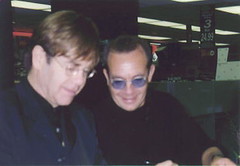
Elton John & Bernie Taupin
Image by Burns! via Flickr

I recently had e-mail from a new, young (14!) songwriter who wanted to know how to come up with the music for her lyrics. Since I usually come from the opposite direction (i.e. I usually come up with music first), it made me think about approaching it from the lyrics first perspective. I sat down and wrote out some lyrics off the top of my head and then realized that I definitely had a rhythm going while I was doing it. Not necessarily a melody, but since I usually write to an established meter with the music already created, I think this brought out my instinct to automatically meter the words.

The difficulty was in developing a melody to them. Elton John is someone who has always taken that role, receiving the lyrics from Bernie Taupin and putting a melody to them. In an interview I saw with him, he discussed how he first reads through the words to get a feel for the “mood” of the song. Sometimes he will change things around (I guess Bernie gives him some artistic license!), making a verse into a chorus or the other way around, adding or changing lines slightly to accomodate what comes to him musically.

Don’t be afraid to let the melody do the “talking”…if the melody starts to write itself a little differently compared to the lyrics, go with it. I heard once that a sculptor looks at the work as already existing within the material…his/her only job is to remove the unwanted stuff. I think you can remove or add lyrics or adjust your meter to make it fit the music and still remain true to the essence of the song.

How to come up with a melody? I once had to write the music to a whole bunch of poems in the play “Through The Looking Glass” (realizing much later that this had already been done professionally!) in high school. This was quite a challenge for me and I worked up quite a sweat doing it! Instead of trying to come up with chords, I “sang” the words…I just repeated them and sung a melody off the top of my head until it developed into something tangible. Then I sat down with the guitar until the chord “sounds” in my head matched the melody. It took alot of patience (when doesn’t it?), and it gave me a whole new outlook into songwriting! Needless to say, I went back to songwriting in my usual way!

Recently a student came to me with a melody she had in her head, but she wasn’t good enough at playing the guitar to play what she “heard” chord-wise. She hummed and I tried all the chords I could come up with and it was pretty frustrating! In the end we still didn’t find it, but she learned more about how to experiment on the guitar until she could come up with it herself!

Coming up with a melody first is my “specialty”. I usually do this by sitting down and experimenting with chord progressions, but sometimes I’m in the strangest places when the thing hits me! Baths are great, so is a walk on a beach for me. Driving the car with no radio or tapedeck playing is good too. What also works for me is learning a new song by someone else…lately Shawn Colvin‘s “Sunny Came Home” has been a source of inspiration…the rhythm of her writing is really catchy and the progressions in that song are terrific. I don’t copy it, of course! But when I learn something new, it often brings out something new because the mood of it can inspire. Or I play it wrong and come up with something else!

There are many schools of thought in terms of writing…my writing is very instinctive and never comes from a “well, this is a ‘C’ so I should be using an ‘Am’ ” attitude. But I have come across a number of songwriters who do exactly that…they come from the theory end of it. In fact alot of serious songwriters study the theory end of music quite voraciously, looking for a clue to writing a ‘hit’. There are all kinds of theories about hit songwriting. For me, I focus first on coming up with something that pleases my ear, and then I worry about whether or not anyone else will like it! Que sera, sera!

Enhanced by Zemanta

Critique and Learn

You may think you’re too new at songwriting to critique…let me tell you a good lesson I learned not that long ago. I had been writing for a number of years, and attended a songwriting workshop where, at one point, we were all supposed to critique each other’s work. Now when I was introduced to some of these writers, I found out exactly how new some of them were to the craft, and I thought to myself, rather ignorantly, how can they possibly help me? I had more “experience”!

As it turned out, they gave me some very valuable ideas, and, most of all, they were able to hear from a totally objective point of view and tell me what DIDN’T MAKE SENSE. You might think you have adequately told your story, until someone comes along and says “How did you get to there from here?” and “What does this mean?”

That’s why I’m a firm believer in critiquing as a way of learning your own craft. What “errors” can you pinpoint in a song? If you just have a feeling about some part of it, can you put it into words, and understand what needs to be corrected?

Most importantly, you will be more open to critiques of your own material! Why? Because you will begin to understand the thought and work that goes into critiquing properly and respect that.

So here are some general rules to critiquing:

  1. “Critique” is defined as critical assessment or evaluation. Anyone can “trash” a song (I’ve heard and read some really bad trash), it’s easy to just say something doesn’t work. Can you say WHY it doesn’t work? That’s where the evaluation comes in.
  2. Look at the song in the same way you would your own. What feels awkward or doesn’t fit?
  3. If possible, give an example of what you might do to change it. This is an excellent exersize in problem-solving for you! Tell them how you did what you did. Sometimes there is not enough time to give examples of everything, but if one seems obvious to you, spell it out.
  4. Never, never say “should”. “You should change this…” implies a hierarchy of some sort and that you know better. Well, if you think you know better, keep it to yourself.
  5. BE SURE to include what you LIKED about a song. It really helps soften up the critiquing you’re about to impart. If you have nothing positive to say about a song, either don’t critique, or spend some good time looking for something.
  6. Remember to take into consideration the style of the writer. A different style may imply a different approach. For instance, some country music works best when the lyrics are conversational but clever. Some progressive rock may imply a less straight up style of lyric-writing. Are there certain styles of music that you loathe? Now there’s a challenge!
  7. The simple things are important. Does the music match the lyric? If there are minor chords, no point in talking too much about what a lovely day it is.
  8. Tell the songwriter that this is JUST YOUR OPINION, and that it must be taken with a grain of salt. They may or may not agree with your assessment. That’s okay! Don’t get your defences up, too! Be humble! Often I’ve had songwriters tell me that someone else said exactly the same thing about the song to them before. This reinforces two things, one is that the songwriter starts to realize that maybe there is a problem if more than one person points it out. The other is that it gives YOU some credibility!

I think there’s alot to say about critiquing, and I may just add some things as I think of them. In the meantime, try it out! See how much YOU learn!

Reblog this post [with Zemanta]

Old Tips from the Old Website

I am gradually going to be moving my old tips and articles into this blog over the next few months.  Here are a bunch of the oldest articles and tips from the original website, started in 1996!:

INSPIRATION VS WRITER’S BLOCK

Sometimes, we just can’t stop the juices from flowing and others, we are absolutely certain we’ll never writer another song again. What causes these extremes? Any number of factors, both within our power, and out of our control.

Now, you don’t need anyone to tell you what to do when the song ideas are flowing one after another–other than to try and hang onto as many of those ideas, lyrically and musically, as you can, even if you don’t get to “finish” them. They just might come in handy when you hit a dry spell! Tape recorders and bits of paper are sources for sudden inspiration when times are tough. I try to record little pieces of music I create on one of those micro-cassette recorders. I remember once finding a tape and wondering what was on it. I found a melody that I’d forgotten about and BANG! Out came a new song. That’s how “ONE MORE” was born.
But what if…what if you’ve been sitting in front of a blank page for days, or even weeks? What can you do? A vicious cycle begins–the less you write, the more you panic–the more you panic, the less you write.

If it’s to a real extreme, I’d suggest you first STOP TRYING so hard for a couple of days. Sometimes it works like reverse-psychology, if you tell yourself you can’t write…well, you never know!

Here are some other tips to get past writer’s block:

  • Get into some reading–new books, fiction, non-fiction, magazine articles, anything
  • Try another instrument–sometimes the sound of a different guitar or a new keyboard sound will get the ball rolling. Play an instrument you don’t normally play!
  • Go for a drive, do some housework or garden work, something that will allow your creative mind to wander.
  • Find a new coffee shop or hangout you haven’t been to before. Go alone and be an observer and open yourself to everything you see and hear (and bring that notebook!)>
  • Listen to some music you haven’t heard much of…classical, alternative, jazz…it just might point you in a fresh direction.
  • Learn a new chord, or progression, or even a whole song…the bigger the challenge the better.

    OTHER WRITER’S INSPIRATIONS

    Benn Skender from Australia writes:

    “I have been writing songs for 6 years (I was 13 at the time, and it felt like a good way to channel all the things that go on in your life as an adolescent!). When I first started writing songs, Mum would take me to concerts and acoustic performances here and there for inspiration. I always left the venue inspired to write. However, I feel now that the music I wrote immediately after visiting these venues was derived from the songs I had just heard. Even if I didn’t know the words to the songs I’d heard, I could always mentally envision the melody line or the syllabic structure of the song. This would cloud my clear, individual ideas and rub off on my songwriting. Looking back upon the songs I had written at those times, I feel that listening to others music and then writing was a bad thing. I threw away all of those songs.

    “I feel my most original work (which is always what you should be most pleased with) was created when there were no ‘melody lines’ in my head, so to speak. I could sit in the stupidest of places (like on a 20 high stack of potato sacks during my nightshift tea break, or listening about control systems in an information systems accounting lecture!), and as long as my mind was clear, I would always write well.

    “In short, the best way to draw upon your own individuality is when you want to write DO NOT LISTEN TO ANY MUSIC, until you have difficulty remembering any of the tunes you’ve recently heard. This usually takes me a day at least.

    “I hope this helps any of your readers, as I’d like to feel I made a contribution to the source that gave me a lot of helpful advice when I was stuck.”

    Tom Barber from Essex, England writes:

    “I find it helpful if I have an idea, to keep it in my head just before I go to bed. When I’m trying to get to sleep I find myself thinking about the idea, so always keep a notepad by my bed to write down my thoughts. Its amazing the next mornign what you find you’ve written!”

    Michael Martin writes:

    “I have four things to mention as solutions to writer’s block.

    “One: Force yourself to go out there in the world and do something completely new. But it has to be large enough to invoke inspiration. Hike up a new mountain ridge (geographically permitting), see a big outdoor music fest, meet a new love/friend, take a vacation (and a mini cassette recorder). When you get back, sit down and see if something flows. Or quit an old habit or take care of something important you’ve been putting off. Inspiration strikes me when a new and impacting change comes along. So, sometimes I just help it come along quicker.

    “Two: Be patient. If you’re not feeling inspired, don’t worry, it will come out of the blue if you’re progressing naturally in your life. A body in motion tends to stay in motion. So play scales or your top 5 favorite songs. Work on the arrangements for other instruments. Don’t be impatient, be faithful that you will see the lull pass. Don’t force yourself here. Good work takes time. You rush a miracle and get bad miracles. And remember, when it rains, it pours…try and milk the inspiration for as many songs or song pieces as you can and refine them later. Pieces may fit together later, atheme may emerge, or whole, perfect songs may pop out almost faster than you can write ’em down.

    “Three: Get out of your typical style or genre. Dig back in your distant past and try and learn to play or sing songs from your early influences. New progressions and styles will inspire me almost as much as playing on a newly acquired instrument.

    “Four: This may sound silly, but I drink sometimes to help me loosen up and be less rigid in my songwriting style. I seem to be better at making up spontaneous but original lyrics when I slacken my inhibitions and seriousness up a bit. Just enough to see things in a different way. Again, having a new view of the world will present new avenues for content near as much as playing on a new instrument.”

    Tim Floto writes:

    “Here are several things I do to get new ideas.
    1. Go to the beach. Theres always a tune or lyrics to be had there. It’s life at an edge, interesting things are always happening.
    2. Try going some place you’d never go. For me a bowling alley, pool hall, shopping mall stores are a source of new and about face ideas.
    3. Read through random entries in a dictionary. This will kick in new words and word connections.
    Also, I always carry a notebook (it’s the law!). I can’t always have a guitar with me but I always carry an emergency harmonica or two, and a microcassette recorder.”

    Scott Cairns of Australia writes:

    “Dear Irene, A great way of getting song inspiration that is simple and fun is to simply go to the movies! I heard that Buddy Holly wrote ‘That’ll Be The Day’ after watching the classic John Ford western ‘The Searchers’. A famous musician in Australia, Jon Stevens, wrote a song called ‘Burning Crosses’ after seeing the movie ‘Mississippi Burning’ How often have you walked out of a movie theater and felt emotionally charged? This is when the most powerful songs come about. I would find it hard to believe that someone wouldn’t be moved after watching ‘Braveheart’ or ‘Beaches’. You don’t have to write about the movie specifically. You might write about a man who never got a fair deal in his life after watching Mel Gibson portray William Wallace in Braveheart. The possibilities are endless. Don’t forget those classic novels too! Even the newspapers can stir up some strong feeling about what’s happening in the world. Bruce Springsteen reportedly wrote the album, ‘The Ghost Of Tom Joad’ based on what he read about hispanic immigrants etc in the Los Angeles Times. I hope your readers find this of some value.”

    Brian Allossery of Toronto writes:

    “I like to turn on the tape recorder and just start playing, pick any idea that is hanging around in my mind, and keep banging away at it, even singing nonsense lyrics for parts that don’t occur to me right away. I often find the final polishing gets done at the session because the pressure to finish it is very great. Another way I’ve come up with some of my best material is to hire a producer I really respect, and it seems to inspire me to focus and come up with the best of what I have at the moment. Partly because I want to impress them and partly because I don’t want to embarass myself.”

    Seth Davidson writes:

    “Inspiration Tip: Live in a shitty situation for half a decade or so, then discover that life is really pretty damned good. Works every time.” (I e-mailed Seth back with a one-word response…”yikes!”)

    Donald C. Dees writes:

    “Irene; I fully agree with you about carrying a ‘mini-cassette recorder’ with you at all times. It is simply not feasable and too dangerous to try to write a new lyric or chord progression while driving down the road at 70 mph. Sean Holland suggested taking a trip and leaving your guitar at home. On this point, I disagree. I go by this philosophy, ‘I’d rather have my guitar and not need it than need it and not have it’ You never know when you might be inspired to write a new song or just play to entertain yourself (and maybe others) at a dull party or some other gathering.”

    Brian Hutzell writes:

    “Take a walk on a crowded street, or sit in a busy diner, and LISTEN. Eavesdrop on conversations. People are interesting creatures and often say interesting things that might spark some ideas. Lots of listening will also help make lyrics more conversatonal.

    OR A game I play when I’m stuck is simply to rip myself off. I’l take an old song of mine and try bizarre things with it: turn the page upside down, switch cleffs, change key and/or time signatures, play it backwards, randomly dot some notes. The result is usually on the strange side, but it opens up new melodies and sounds which I might not have discovered otherwise.”

    Sean Holland writes: “How about this: Go on a trip and neglect to take your guitar. Go crazy for a few days or a week without playing a note. Come home, grab the axe and VOILA, something new pops out. Well, sometimes.”

    I’ve heard all kinds of strange tricks for inspiration. What are yours?

    Add your tricks to the Comments section below!

    LYRIC FRAMEWORK

    I went to a Power Songshop weekend back in November, put on by the Songwriter’s Association of Canada, and met three very talented songwriters: Cyril Rawson, Dean McTaggert and Tom Wilson. Each of them took four of us under tow, and in smaller groups we worked diligently on our songs…what a hoot! Imagine a whole weekend hanging out with songwriter’s and doing nothing else but focusing on your material! These workshops I would highly recommend, and I would also like to share with you a lyric framework written by my group leader, Cyril Rawson. Go through this list when you are at the re-working stage of your writing, it’s well worth it!
    LYRIC FRAMEWORK
    1. Memorable Title: identifiable, memorable, substantial for music, puts singer in favorable light, makes you want to hear it again.
    2. Strong Start: pulls listener into song, established who, what, when, and where, immediately.
    3. Progression: arranges things in a logical, meaningful sequence. Draws a conclusion, stated or implied.
    4. Appropriate Music: supports and enhances the lyric content. Desired effect: happy, sad, angry, etc.

    SONG PLOTS
    1. Attitude: an emotion or attitude is expressed.
    2. Situation: the attitude is given a situation.
    3. Story: the plot has a beginning, middle and an end.

    WRITING PRINCIPALS
    1. Simplicity: keep to one idea, eliminate sub-plots.
    2. Clarity: make clear who is doing the talking or thinking. Him, her, they, them, it–make it clear, show any changes of time, setting, viewpoint in a transitional line. Don’t assume!
    3. Emphasis: use important words at the end of the line. “Active” voice verbs over “passive”. Rhyme words you want to stress.
    4. Consistency: keep the tone and language style the same throughout. Keep theme words the same meaning: eg. “rain” – real rain or trouble.
    5. Gender: choose the appropriate gender for the story.
    6. Viewpoint: 1st person (I), 2nd person (you), 3rd person (he, she, they)…don’t change without explaining or introducing the new person.
    7. Form: verse, verse chorus, verse chorus verse, bridge, chorus, etc.

    So, there you go, and thank you Cyril for a great guide to combing through lyrics with a sharp eye to polish those wonderful songs!

    PLEASE YOURSELF

    So here I am offering to give you some advice, and then telling you not to listen! Actually, what I’m trying to say is that ultimately the most important thing you have to do is to PLEASE YOURSELF. Nothing can put out the creative flame more quickly than second guessing before you’ve even begun to put the pen to paper or the fingers to strings. Try it sometime…take in a book on songwriting and then sit down to write. You’ll probably have big wet marks on the armpits of your brand new writing shirt in no time.
    What pleases you? Certain chord progressions? Certain lyrical turns of phrases? Whatever turns your crank, do it. Then when you have a rough idea of the song, that’s where the work comes in. Are you going to perform it? Try to get it to a publisher? If you answer yes to either of these questions, then you have to start considering your audience and what they will hear (see below). And MOST importantly, you have to finish it (even if you don’t like it!) Why finish a song you don’t like? Because you really don’t know if it’s a write-off until it’s completed, AND because the discipline of finishing what you start will be most helpful to your songwriting skills. Do you have a bunch of unfinished songs lying around? There you go! Hasn’t got you anywhere, has it?

    …AND HOW ABOUT THAT AUDIENCE?

    There are many schools of thought as to how much or how little you hit the audience over the head with your lyrics, for instance. This will also depend upon your style of writing. Country songs are usually (and I do qualify that!) straight-up-the-middle lyrically, whereas progressive rock may be almost completely obscure. The music will also be most effective if you take into consideration the audience you’re writing for…do you want to take them on a trip, make them happy, miserable?
    Of course, the quickest way to find out if a song has any impact is to share it with an audience. I go to a local folk club on occasion and try out my new stuff. I know I’m not going to please everybody, but if somebody approaches me afterwards to mention how much they liked something, I take note! Another option is to join (or begin) a songwriter’s group in your area. A few people you trust may really help to define the strengths and weaknesses of your material. You might take turns critiquing each other’s work. But do remember that these are opinions…if somebody points out an area that you already had trouble with, then that’s exactly what you’re looking for. If somebody says something that seems totally off-base, then you politely thank them and move on! Don’t always trust that your friends or family are going to be able to give you a good evaluation of your work…unless they are absolutely into your style of writing, most of the time they will want to encourage and support rather than point out the problems, which is nice but not helpful.

    CLICHES

    This has to be the most frustrating part of writing lyrics…how to say the same thing, but not the same way. How many times have we heard “I love you” or “I never want to leave you” in a love song? Now actually, in some genres, such as country, cliche’s can be used quite effectively in a twist, but more commonly (good word!), we use those old lines or phrases because we haven’t been able to say it in a more creative way.
    Here’s one solution: in workshops, I get people to sit with the “offending” phrase and off the top of their heads, write free hand everything they can think of relating to it. Try using metaphors, describing physical feelings, visualize a moment, use long sentences or just one or two word descriptions, anything that will take you away from the temptaion to use it. Once you establish a fresh feeling about what you are trying to put across, then try to fit it within the meter and the rhyme of your song. You might end up changing a whole verse because of it, but that’s okay! What you end up with will be more unique and ultimately stronger. And don’t forget to read, read, read. Reading fiction, non-fiction, poety, and lyrics helps to expand your vocabulary!

Enhanced by Zemanta