You’re As Strong As Your Weakest Part

© I.Woloshen

I used to be a lousy lyricist…maybe I had nothing to say, maybe I just let that part of my songwriting go, maybe I was just plain lazy! It was something I swept aside in my frenzy to write great music, especially when I was in my 20’s. I was impatient to finish…ever feel that way? These days, I have an endless supply of patience, but I digress…

When you get to the point of looking at the first draft of a song is when your weakness becomes most apparent. What is it that you’re skipping over in order to get the darn thing written? You know yourself better than anyone else, and this is when you have to be the most honest. When I say to be honest with yourself, I don’t mean that you need to be hyper-critical, just that you have to come face-to-face with the part of the song that isn’t “there” yet. This is the part of the song that will stand out to those who spend hours and hours listening to amateur songwriting, the people in the business. You can bet that they’ll pinpoint your weak point instantly!! You can’t hide it!

This weakness in your songwriting may take some time to strengthen, so be prepared! You essentially have several choices:

1. You can spend the time necessary to develop your skill in this area…for instance, because of my weak lyrics, I did a lot of reading and worked at writing a journal over a long time. When I would write in my journal, every now and then I’d come up with a line or phrase that stood out…that was the beginning of knowing I had my own point of view to express. If music is your weakness, push your envelope! Get out there and learn something…take a guitar class, learn some theory or join a choir and get a feel for how melodies and harmonies work together. There are endless possibilities.

2. You can skip the learning part and get yourself a co-writer. Find someone who has the skills you are missing…maybe they will be missing what you have! It isn’t easy at first to find someone suitable, but there are many, many songwriters out there who co-write. On Jeff Mallet’s site Lyricist.com you’ll find a huge list of songwriters broken down into lots of categories, including location.

3. If songwriting is your hobby, as opposed to a career pursuit, you have the luxury of time and little pressure 🙂 You may not be driven to change anything about the way you write, but even hobbyists like the idea of improving on the craft! Most of the books you’ll see on songwriting are primarily geared towards commercial writing, but there is a great book called “The Artist’s Way” by Julia Cameron which focuses mostly on the creative side of yourself that you may find very helpful. It deals with “recovering your creative self” and although it doesn’t speak specifically about songwriting, I’ve heard many songwriters recommending it highly. If you are interested in other songwriting books, check out the Muse’s Muse for a whole list of ’em!

4. “Time…is on your side, yes it is…”…but for a great period of time in my songwriting “life” when I wasn’t focusing on improving it, I didn’t! There is no magic formula or pill. If you wanted to play better golf, you would probably consider taking lessons, or practicing as often as possible, maybe on a driving range…in other words you would focus in on your game and give it the time it deserved. The same is true of anything, including songwriting. When I focused in on my weaknesses, I learned to write better songs. Simple as that.

You will probably always feel more comfortable with one aspect of your writing, the part that comes naturally…it’s easy to ignore the rest when it’s too much “work” to fix it. But if you’re interested in getting your songs heard by others…it’s something you can’t ignore anymore!

PRODUCTION WEAKNESSES:

If you are considering sending your demos out to publishers…here are some problems that relate to production that you may not have considered (some I’ve heard and been guilty of from time to time myself). Seriously think about going to a professional studio to do a decent production on the song.

1. If you are a great keyboardist, vocalist, etc., etc., but you can’t program drums worth a damn…THAT’S exactly what the publisher is going to hear first…those lousy drums! Don’t you dare think you can hide them 🙂

2. Vocal buried in the mix…it doesn’t seem to matter how many times I’ve heard publishers, etc., say this, songwriters STILL forget that the lyrics are half the song and if they can’t hear ’em, they won’t listen any further!

3. Self-indulgent solo leads…come on, maybe your favourite part of recording is putting down that nice over-effected guitar lead that you just can’t play enough of…but that’s when the machine is going to get turned off. I’ve had demos sent to me when the songwriter raved about his guitar part, as if the song itself had very little to do with it!

4. Bad tempo shifts – I hate over-quantification, don’t get me wrong…there’s nothing that beats a “real” feel or groove in a song. But it’s got to be tight, it has to feel solid tempo-wise. Even if you’re just playing a simple keyboard or guitar and vocal, keep it on time!

5. Forgot to tune – oh, there’s no excuse for this one! Tune all of your instruments first…new strings on guitars if you can, don’t give somebody another reason to hit the “stop” button!

6. Lo-o-o-o-o-ng Intros – are for performing songwriters who can get away with it…if you’re pitching, don’t bother with much of an intro, get to the song as soon as you can! Equally true with long extros…nobody’s going to be listening that far into the song anyway!

7. And last but not least – REAL fancy production, but weak song. Let me tell you right now, you can’t hide a lousy song with great production. Somebody’s going to see that one right away. Make sure your song is “there” first before you even THINK of anything else!

Well, as I said, you are as strong as your weakest part…as soon as you figure out what that weak part is, you’ve got it made!

Reblog this post [with Zemanta]

Meaning and Metaphor

© I.Woloshen

Recently, someone in rec.music.makers.songwriting posted a question as to why many of the songwriters in the group didn’t seem to make much use of metaphors in their lyrics. Actually, I’ve seen them used quite a bit…but I do think that some writers are intimidated (even by the word!) and don’t know how beautifully it can paint a picture if used well. I’ll try to give some examples as I go, but first I’ll give you the definition if you’re not quite sure what a metaphor is:

In the Webster’s Dictionary, “metaphor” is defined as: “Transference of a term to something it does not literally apply to…”. Probably the most familiar setting of a metaphor would be with the words “like a” as in “I ran like a bat out of hell”. Someone recently pointed out to me that this is more accurately called a “simile” which is defined as “comparison, especially in poetry”. To insert “like a” does technically make a difference in how you define the term, however, the idea is the same. Here’s a line from a Shawn Colvin song called “Steady On” on her album of the same name…

‘I am weaving
Like a drunkard
Like a balloon up in the air
I am needing a puncture
And someone to point me somewhere’

What’s nice about these similes is that she carries the image through to the rest of this verse…you can really let your head go off in some interesting directions lyrically when you get a vision of something you’re trying to describe. The fact that she’s weaving like a drunkard could imply that she’s admiting to irresponsibility or being out of control…the “puncture” line seems to imply that she really needs a dose of reality. The interesting thing about similes and metaphors is that although they may be trying to evoke something specific, they can, in fact, take the listener on a very personal trip. I’ve found many times that people have interpreted my songs in their own way. I like the idea of someone being able to put their own stamp on something I’m expressing. You can’t really be too inspired with lines like “You broke my heart” after you’ve experienced some truly fascinating lyric-writing. Here’s an example in an early Joni Mitchell song called “You Turn Me On (I’m A Radio)”(definitely a metaphor!!):

‘Oh honey you turn me on, I’m a radio
I’m a country station, I’m a little bit corny
I’m a wildwood flower waving for you
I’m a broadcasting tower waving for you’

Here she personifies what she is describing…I can only imagine her getting into the visuals of some small Saskatchewan town (in the Canadian prairies where she grew up) pulling out and playing with all of these images. This is only one of many, many examples of Joni’s craftiness and creative use of imagery. She has the uncanny knack of stuffing a novel full of images all in one line. Everytime I go back and listen to a song of hers I’ve heard many times, I find some new dimension to it, a new meaning.

Which brings me to the “meaning” part of songwriting. Cliché’s are one thing, but over-used phrases as the “You broke my heart” line above, really don’t have any life of their own. They don’t evoke emotion, which is a very powerful tool for a songwriter. How can you bring your song to life, and give it deeper meaning? One way is to listen to examples of others who have a knack in this area. Another is to try free-association when you’re writing. Don’t worry about the meter or anything else, take the line and sit down and come up with as many images you can around it. For example, Joni’s trick of being a “wildflower waving for you”…the wildflower waving is a great visual, and the fact that it’s waving “for you” and not “at you”, gives it a supportive, positive feel. All that in one little phrase!

In a song I wrote (uh-oh, she’s getting desperate now!) called “Fusion & Fire”, I had alot of fun playing with metaphors using the universe (literally) and planets as a theme for long-lasting love. I also used Joni’s trick of personification in that one. Mary-Chapin Carpenter wrote a brilliant song called “This Shirt”…in it she basically used the shirt as a time-reference for a love affair, where it travelled, how it was used as a pillow, the sleeve rolled up with a pack of cigarettes, how she wears it now when she’s doing the housework…from a stinky old shirt, you get so much! Here’s a bridge from a Shawn Colvin song called “Set The Prairie On Fire” from her “Fat City” album. This bridge gets to me everytime I hear it…it just screams passion:

‘In the cool dusk of horses
Through the rusted wires of sleep
With our arms around midnight
We’re headed for release
We go riding in the wind
We go riding in the dark
Riding, riding…oooh’

Now, don’t you wish you could fire up those kinds of images? Don’t ever compare yourself with others, that’s a waste of time because you are unique. But DO admire others clever crafting, reading or listening to it could put you in exactly the space you need to be more creative with your own writing. And try a metaphor today!

Reblog this post [with Zemanta]

Attitude is Everything

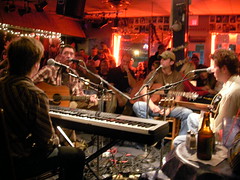
Songwriter Session at the Bluebird Cafe: Jamie...
Image by TedRheingold via Flickr, Bluebird Cafe

Even though we songwriters tend to seclude ourselves sometimes when we’re trying to come up with another tune, there does exist a community of songwriters out there. It includes professionals and amateurs, young and old, rock, country, and all of the other genres, and male and female. Each has unique perceptions and experiences to bring to their craft; each is driven by a desire to express and create something.
What I find most interesting is the attitudes expressed and how those attitudes can completely colour my response to a songwriter‘s material. Recently I remember reading a post in the newsgroup rec.music.makers.songwriting from a songwriter who began to list the subject matter that he thought “sucked” in songs. He included any songs you write in the first person, love songs, any kind of relationship songs, and the list went on and on. I was immediately aroused from my complacency, since I most often write about those very topics! It made me think about what it is in a song that appeals to me and what doesn’t, which is a completely relative experience, but I responded with a post saying that it isn’t the subject that “sucks”, but the way in which that subject is handled. What interested me even more was how this person had essentially dismissed the majority of songs and songwriters out there with his attitude. Occasionally the “dark” side of creative immaturity and competitivenss rears its ugly head and reminds me of where I came from.

We’ve all been there. That “I can write better songs than that” string of thought that temporarily boosts our egos when we hear someone else’s material that doesn’t live up to our expectations. It’s too easy to fall into that frame of mind when we’ve had to struggle with our own writing and the self-esteem gauge has dropped below zero. I’ve been to demo critiques in which the “experts” literally devastated the songwriters who were there, and others where the complete opposite has happened.

It’s a tough world sometimes, but the people I’ve admired most are those writers who seem to roll with every punch and have enough energy left to encourage and help others. And the conclusion that I’ve come to, the thought that has helped me more than anything else, is that THERE’S ROOM FOR EVERYBODY! We won’t all make a fortune from writing, or have great recognition, but the talent that exists is extraordinary! Sure, songwriters in the “business” have to compete with others to a certain degree, but it can be done with such graciousness. I’ve heard staff writers talk about sharing writing credits with a person in the room at the time a song was written because that person came up with one line or one phrase. That’s the kind of generosity and maturity we all need to emulate. Time and experience will teach us that, when it comes to the big picture, having written the best or worst song in our lives doesn’t really amount to much, that the value is in the process and in the community we build with each other. You can’t help but be lifted up when you lift somebody else up. These days, instead of trying to figure out what makes a song “suck”, I try to understand what makes it great…if I don’t like a song, rather than getting comparative, I move on to the next one…I take a step back from my ego every now and then and appreciate the process. Songs don’t “suck”…bad attitudes do!

Enhanced by Zemanta

Critique and Learn

You may think you’re too new at songwriting to critique…let me tell you a good lesson I learned not that long ago. I had been writing for a number of years, and attended a songwriting workshop where, at one point, we were all supposed to critique each other’s work. Now when I was introduced to some of these writers, I found out exactly how new some of them were to the craft, and I thought to myself, rather ignorantly, how can they possibly help me? I had more “experience”!

As it turned out, they gave me some very valuable ideas, and, most of all, they were able to hear from a totally objective point of view and tell me what DIDN’T MAKE SENSE. You might think you have adequately told your story, until someone comes along and says “How did you get to there from here?” and “What does this mean?”

That’s why I’m a firm believer in critiquing as a way of learning your own craft. What “errors” can you pinpoint in a song? If you just have a feeling about some part of it, can you put it into words, and understand what needs to be corrected?

Most importantly, you will be more open to critiques of your own material! Why? Because you will begin to understand the thought and work that goes into critiquing properly and respect that.

So here are some general rules to critiquing:

  1. “Critique” is defined as critical assessment or evaluation. Anyone can “trash” a song (I’ve heard and read some really bad trash), it’s easy to just say something doesn’t work. Can you say WHY it doesn’t work? That’s where the evaluation comes in.
  2. Look at the song in the same way you would your own. What feels awkward or doesn’t fit?
  3. If possible, give an example of what you might do to change it. This is an excellent exersize in problem-solving for you! Tell them how you did what you did. Sometimes there is not enough time to give examples of everything, but if one seems obvious to you, spell it out.
  4. Never, never say “should”. “You should change this…” implies a hierarchy of some sort and that you know better. Well, if you think you know better, keep it to yourself.
  5. BE SURE to include what you LIKED about a song. It really helps soften up the critiquing you’re about to impart. If you have nothing positive to say about a song, either don’t critique, or spend some good time looking for something.
  6. Remember to take into consideration the style of the writer. A different style may imply a different approach. For instance, some country music works best when the lyrics are conversational but clever. Some progressive rock may imply a less straight up style of lyric-writing. Are there certain styles of music that you loathe? Now there’s a challenge!
  7. The simple things are important. Does the music match the lyric? If there are minor chords, no point in talking too much about what a lovely day it is.
  8. Tell the songwriter that this is JUST YOUR OPINION, and that it must be taken with a grain of salt. They may or may not agree with your assessment. That’s okay! Don’t get your defences up, too! Be humble! Often I’ve had songwriters tell me that someone else said exactly the same thing about the song to them before. This reinforces two things, one is that the songwriter starts to realize that maybe there is a problem if more than one person points it out. The other is that it gives YOU some credibility!

I think there’s alot to say about critiquing, and I may just add some things as I think of them. In the meantime, try it out! See how much YOU learn!

Reblog this post [with Zemanta]

Does It Matter?

Beyoncé Knowles singing "Dangerously in L...
Image via Wikipedia

Beyoncé has had a very successful career, starting with the group Destiny’s Child which rose to fame in the late 90’s, and more recently on her own with several albums as a solo artist.

However, all through her solo career there have been rumours that the songwriting credits she receives (and awards, I might add) don’t really belong to her. She began receiving those credits with Destiny’s Child, and according to the Wikipedia site: “Knowles was recognized as a songwriter during the run of Destiny’s Child in the 1990s and early to mid-2000s. She won the Songwriter of the Year award at the 2001 American Society of Composers, Authors, and Publishers Pop Music Awards, becoming the first African-American female and second female songwriter of all time to accomplish the feat. Knowles received three songwriting credits in a single year for co-writing “Irreplaceable”, “Grillz” (“Soldier” was sampled on the song) and “Check on It”, the only woman to achieve since Carole King in 1971 and Mariah Carey in 1991. In terms of credits, she is tied with Diane Warren at third with nine number-one singles.”

That last sentence is the one that caught my eye. Tied with Diane Warren? If you are a serious songwriter, you know who Diane Warren is. If you don’t, she is probably the most prolific and successful songwriters around, receiving not just Grammy’s but also Academy and Golden Globe awards and nominations, and she has been ASCAP‘s Songwriter of the Year six times. She is not a performer, all she does is write. She is 53 years old.

Beyoncé is 28. I can appreciate that she may have shared bits and pieces of songwriting ideas with co-writers, but considering how hard she works, appearing not just in her own concerts but also on Broadway and in films, I cannot believe she has the time to write, let alone write these massive hits.

I recently found the link below, which further exacerbates the rumours. A recently-fired Sony Music (Beyoncé’s label) person apparently has confirmed that Beyoncé essentially just demands writing credits and sometimes pays the songwriters off in order to receive them. You can read the post and follow the link to the Sony letter yourself:

Lipstick Alley Link

At first I scoffed at the fact that this is a celebrity gossip site, so who can trust that? But after I read Beyoncé’s bio, I think there is probably some truth to it.

So here’s my question: does it matter? The general public won’t care too much who wrote the song. But as a songwriter, you should be concerned about this practice. This is what happened to a lot of blues artists a number of decades ago in the U.S.: the record labels would lay claim to all of their songs, and these artists who usually wrote their own songs often died in poverty while the labels made gobs of money. As a songwriter, if Beyoncé offered you a tidy sum of money for a song of yours, you’d probably be so flattered (and maybe even impressed at the amount offered!) that you would be tempted to take it. And that’s your choice.

But it’s a crappy practice. It’s dishonest and it takes advantage of those who are SO OFTEN taken advantage of by people in the music business. It’s your song, you should ALWAYS be given credit for it. It may be the last number one song you write, don’t kid yourself. Most of us aren’t Diane Warren’s who are set for life because of all of the hit songs with our names on them out there. Most of us will be lucky to see even a little success from one or two songs in our lifetime.

Demanding songwriting credits is a greedy and self-serving act, and any artist or songwriter who does it should be ashamed of themselves.

IJ

Reblog this post [with Zemanta]