How I Critique

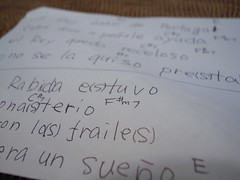
Song lyrics
Image by matsuyuki via Flickr

© I.Woloshen

Critiques can be brutal. Most of the time, the level of brutality is in direct relation to the thickness of your skin! I used to scoff and bristle at ANY suggestion that my songs might be less than perfect! How dare they!!??

More and more, I come across this scenario…people send me their lyrics for critique, I spend some time on them and send a reply, and never hear another word! Is it that I’m expecting you to love what I say? Not at all…you’re not likely going to agree with everything, in fact you may outright disagree with every word! I am not an insensitive boor who loves tearing other songwriter‘s work apart, but I DO tend to be quite upfront about the weaknesses and the strengths, whatever they may be. Therein lies the point…what do you expect of a critique?

The first and most important point…I can never emphasize this enough…is that it is nothing personal!! I can love you as a person and not like what you wrote! I can just as easily think you’re a twerp and LOVE your writing! Okay, I’ll admit that there are VERY few people in this world that I totally dislike 🙂

Secondly, I am at least equally as hard on myself when it comes to my own writing! I will never say anything to you that I wouldn’t say to myself…in fact, I’m probably easier on you than I am on me because I don’t know how for sure how sensitive you might be. The truth is that I want you to get better…and how can you improve unless you can identify your weaknesses? I want the same for myself.

I do not treat anyone differently…the only exception to this would be a very young songwriter (in age, not experience), in which case I try to be more encouraging. If a nine-year-old came up to you with her first serious effort at drawing a cat…you’d think twice before getting too critical.

Lastly, I compare ALL lyrics/songs with those on a professional level. If you want to be a carpenter, you have to set your goals in such a way that you can compare your work with the best darn carpenter you know. Even if you intend only to be an amateur songwriter, the very fact that you’ve sent your lyrics to someone for a critique shows that you want to be good at it, no? Otherwise, why bother?

In my experiences being a reviewer on Gods Of Music , I’ve noticed a number of things in the feedback artists/bands give reviewers when they get their reviews. This is a really common response…”you didn’t get my song/you didn’t understand my music”. Who’s responsibility is it to get the message across, the reviewer, or the songwriter/artist? If someone doesn’t understand your music…especially if a number of people don’t, you have to start looking at whether or not you are doing enough to communicate in your songs. You are putting yourself out there into the “big, bad world” of the music industry and they are not going to be nice. They are going to be brutally honest. So get used to it!

Another response…”I got a great review at (some other obscure reviewer or article)…”. This doesn’t mean anything…all it does is reflect the wide variation of responses you will inevitably get to your songs. Don’t expect everyone to feel the same about your song…you don’t feel the same about every song you hear!

There are also various other defensive responses you see from songwriters and artists who are pretty new to this idea of criticism. On the other hand, I see many who respond in a mature, gracious manner to whatever feedback they get. If you don’t get the “that’s a number one hit!!!” response the way you thought you would, take a long breath before you put your fist through the wall 🙂 It takes time, tremendous luck and a whole lotta talent to begin to compete with the rest of the music world.

I sincerely hope that EVERY SINGLE PERSON who asks me for a critique reads this very article first, in order that they understand what I’m going to do. To be painfully honest, if you are looking for a pat on the back ONLY…don’t ask for a critique. Instead, play your song to your friends and family. They will ALWAYS accept what you do because they love you!

(PS…Irene is no longer giving personal critiques other than her work with Gods Of Music, but you can request a critique on the Messageboard!!)

Reblog this post [with Zemanta]

Step By Step

© I.Woloshen

This is a more recent song lyric that was born from one line that hit me in the car (don’t worry, I wasn’t hurt 🙂 )on the way home from dropping the kids off at school.

I thought it might be an interesting thing to take you through the process I went through in creating this lyric. I have mentioned before that usually my songs come from a “music first” place, but in the last couple of years, I’ve noticed a tendency to come up with a line and melody at once.

I saw a man that I’ve seen many times, walking down the street. I don’t know him personally, but when I look at him, he reminds me of someone…

“There is a man who looks like Truman Capote

That was the line…now I had no idea where the song was going to go, I had only that line! What on earth was this song going to be about? Some people start with a central idea or theme…these days, I tend to write the first line and then try to build a song from there.

So I recorded it into my trusty micro-cassette recorder, and left it for awhile. Later, I pulled it out, along with my guitar, and started playing around with it. The melody had come at the same time, so I picked a chord and a key and let the words kind of come out as I was creating the melody.

Okay. There is a man who looks like Truman Capote…I thought I’d give a bit of a description next:

There is a man who looks like Truman Capote
He wears a slanted smile and a wide-brimmed hat
A little pigeon-toed, a lot eccentric
He gets a kick out of what he’s smiling at
And as I pass him on the street I wonder
What it is he’d have to say…

But what’s the song about? At this point, I remembered something my Dad talked about once…how he always remembered the “characters” that were around when he was a kid: characters who had idiosynchracies or looked or spoke a little strangely whom he never forgot.

This made me think about another older woman who we buy pumpkins from every year…she has an old house and some property and it’s become our tradition to always buy our hallowe’en pumpkins from her:

There is a woman, must be in her nineties
She sells her pumpkins every Hallowe’en
She’s all bent over with the weight of something
But every year, her crop’s the best I’ve seen
And as she prices out the one I’ve chosen
I wonder what she’d have to say

Now it seemed was the right time for a chorus…as it turns out, I wrote a melody and a different chord progression, but no lyrics! I just hummed a melody. Now, that’s not very conventional…but somehow or other, it works. If it feels good, do it 🙂

So did I just want to write about characters? I could probably think of others, but at this point, I decided to take a different direction:

A friend of mine who rides the bus on weekdays
With sixty travelers she’ll never know
She looks at every one and writes their story
To entertain herself when the ride is slow
If she saw Truman and the Pumpkin Lady
She’d know just what they had to say….

All of these people are real people…there really is a friend who does this…I always thought it was an interesting way to pass the time on a bus! It just goes to show that little bits and pieces of ideas and thoughts can stay with you and come in handy in your songwriting sometimes. And it gave me the title of the song…again, not very conventional, because there’s no lyrical chorus, which is where the title is more commonly found. So I decided at this point to call the song “Truman and the Pumpkin Lady”. Kind of unusual :-). Now I needed to finish the song…how do I tie all of these thoughts together? This is what I came up with:

And as we reach our final earthly hours
Looking back at what our lives have been
It will appear as though a giant weaving
Of every person, place, and time we’ve seen
And maybe someone will pass by and wonder
What it is we’d have to say…

Then I finished with humming that chorus again…a kind of wistful exit to a wistful lyric. One point I’d like to make is that I wrote it all in the present tense…this is intentional. If I had written it in past tense, it would have had less impact. There is an immediacy to the present tense that works very well with this type of lyric.

Of course, the verses didn’t come out all that easily and just as I’ve shown them here…they went through two or three drafts first. And is the song finished? I dunno!! But that’s the story of how it got this far.

***Update*** I finally broke down and wrote lyrics to the chorus…in fact I changed the chorus melody altogether. Why? Because I felt it was missing a summation, outside of the repetition of the line at the end of each verse. Here it is:

Don’t be unkind
Live a simple life
Laugh at yourself sometimes
Look at me now
You’ll be here someday
So love a little bit along the way

When I was in my teens I bought my step-grandmother a little wall plaque, that said “Live, Laugh and Love”. She thought it represented exactly what she believed. So there you go.

Reblog this post [with Zemanta]

Song Structure

"This Old Guitar"
Image by Tony the Misfit via Flickr

© I.Woloshen

Often I come across songwriters who are confused as to the labels we have for different parts of a song. Verses and choruses are obvious, I think! However, what is a bridge? A pre-chorus? Intro? Extro? Here are my definitions (I’m smart enough to know that definitions can change from writer to writer!):

A bridge is a musical and/or lyrical break in the song, often inserted after a couple of verses and choruses. It can, when written effectively, give a little change of pace to the song once the repetition begins to become obvious to the listener. Sometimes I might write a simple musical break with no lyrics, usually in the same key, but with a different chord progression. Lyrics are often part of a bridge, however. I’ve also met pro songwriters who HATE bridges and never write ’em! To each his own!

A pre-chorus is a lead up to the chorus, a kind of “build” if you will. They are not as common as bridges, but can be very effective in bridging the verse just before the chorus.

Intros are at the very beginning of a song, the introduction to it. If you are pitching your songs, better keep your intros SHORT!! Publishers, A&R reps and label execs usually don’t have the patience for long self-indulgent intros, and may give up before you even get to the first verse! Sometimes an intro can be effective by foreshadowing the chorus chords just a little, or a quick build of instruments into the song. When I’m playing live, I may stretch the intro to a song and let it build a groove before I start singing.

Extros are often mis-labeled “outros” (I hate that!)…and are the lead-outs or endings to a song. Again, they can get too long and self-indulgent. The faders on recording equipment back in the sixties and seventies lead to just about every recorded song fading out…! There’s nothing that beats a nice, tight and unexpected ending, though!

Middle Eight – this is a term you might hear that sometimes refers to a type of bridge, and other times is simply an instrumental break, usually (but not always) eight bars long. In a rock song, for instance, it might contain a guitar lead…Eddie Van Halen howling alone on his guitar for eight bars 🙂

Breakdown – sometimes about two-thirds of the way through a song, you’ll suddenly hear just the drums playing alone, or the vocals alone, or hand-clapping, etc., with nothing else in the mix. Then, there will be a build-up of instruments again. This is what is referred to as a “breakdown”. It’s more of an arragement term, rather than a songwriting one. But if you’re in a studio trying to get a good recording of your song, you might use this trick to make your arrangement more interesting.

And here’s my extro…. 🙂

Reblog this post [with Zemanta]