Vowels and Consonants and Syllables – Oh My!

© I.Woloshen

When I was in Grade 7 I remember my teacher, Mr. Fergus, giving us word definition tests every week…I hated them. Words intimidated me for some reason. My vocabulary, I felt, was limited at best, and who the heck needed all of those big words anyway when you could use small ones? I still love the saying “Don’t use a big word when a diminutive one will suffice!”

Most of us understand the K.I.S.S. (keep it simple, stupid) rule when it comes to vocabulary in songwriting. Don’t pop in a fancy word when the rest of the song doesn’t have any. Lyrics seem to be a struggle for a lot of songwriters…they are what I consider to be my weakest element in my songwriting! Why? Well, maybe I still picture myself sitting in Mr. Fergus’ class, dreading the next vocabulary test. As a result, I’ve spent a great deal of time working on my lyrics in the last few years in order to overcome my fear of them. And I’ve learned a few things along the way!

Most importantly, words aren’t just a bunch of letters strung together, they can actually “sing” in a lyric! Some words even sound like the emotion or sound you’re trying to express…”hiss” is one that comes to mind. These words are called “Onomatopoeia“…other examples are clang, pop, ding, wham, splonk, and splat.

You may have heard the term “scan” in a songwriting context. When a line in a song scans well, it has a flow to it, where the sounds of the words, the vowels and consonants all flow together beautifully. A line that scans well is easily sung. One that doesn’t, feels like a tongue twister!

The wrong word in the wrong position can completely blow a line….it can throw the tempo and feel off entirely. A lot of this comes from a songwriter not spending enough time and attention on the lyrics, including misplaced vowels and consonants, and bad placement altogether.

Oh, oh. We’re in English 101 class again 🙂 What is a vowel? Do you remember? A,E,I,O,U and sometimes Y. In the English language you can get two different sounds from each of these vowels, and different sounds from combinations of them. Bonus! And what are consonants? All of the other letters. I’m going to assume you know what a syllable is 🙂 What I want to discuss here is what vowels, consonants and syllables have to do with WHERE you place a word in a lyric and HOW you use it!

Let’s look at any old word…how about the word “it”. The “i” in “it” is a short sound…so an easy rule to remember is “short sound, short note”. For instance, you don’t want to sing the word “it” over a whole note (4 beats). Not only is the “i” in “it” short, but the word has only one syllable. And NOT ONLY THAT, but the word itself is not all that significant. What does that tell you? Don’t put it in a powerful position! For instance, here’s a simple line:

Don’t you know it

If you say this line in conversation, which words would you stress or emphasize? Probably “don’t” and “know”…the “you” and the “it” are not as significant. If you emphasized the phrase this way: don’t YOU know IT…it wouldn’t sound right!

Now look at that line again from another perspective. Which words could you place the longer musical notes under? The same words that are emphasized:

doooonn’t you knoowww it

The word “you” could also have a longer note under it. But the little word “it” will never work that way, certainly not very well! Words that end with a long vowel and no consonant, like “you” or “goodbye” work well at the end of lines, especially if the note at the end of a line is held for any length of time. Words with a hard consonant ending will SOMETIMES work, as in the example “don’t” above. “Don’t” ends with a hard “t”, but because it has a long vowel sound of “o” in it, the word can be sung over a longer note, and the “t” not sounded until the very end of the note. But it can also be sung over a shorter note, with a very quick ending. So let the natural rhythm of your lyrics dictate the flow of your melody…don’t force them into positions where they are uncomfortable!

Now let’s take a look at a verse of a song you probably won’t know, and you try to figure out how the melody might work with it:

Is this goodbye?
Well we haven’t said a thing all day
It’s almost time
So I’m wondering when the dam will break
(“Let It Go” Copyright © 1996 I. Woloshen SOCAN)

Look at the above verse and see if you can figure out the natural rhythm of the words…this, as we’ve said, is called the meter. It could probably be interpreted more than one way!

If you write music and melody first, which is what I usually do, the rhythm and meter of the melody dictates where a long or short vowel might be. Some people find this much more difficult or limiting when it comes to finding words that will “fit” into those notes. When I’m sitting down and creating a melody, sometimes as I’m singing kind of nonsense lyrics, a line or a phrase will pop out that works well with it. Most of the time I have the melody finished before I even starting thinking about lyrics. But I can always mess a little with the melody to accommodate a word or phrase that I really like. It really is very much like a puzzle, except that YOU decide what the end result is going to be and how the pieces will all fit together!

This is really only a brief introduction to vowels and consonants and syllables (oh, my!), and how they work in songwriting. But the next time you sit down to write a melody to your lyrics or fit some lyrics to your melody, pay close attention to the “sound” of the words, not just the sound of your notes!

Reblog this post [with Zemanta]

Chord Keys

© I.Woloshen

Here’s an email I received recently:

“Irene,

If I write a song and start playing the first chord as (A) what other chords can I use that would fit. Usually I go to the C to G type, but that’s because I’m limited. How can I find a wide selection of chords that would that would fit ? especially with minor chords.”

When I first started to learn how to play guitar, every new “neat” chord or progression I learned ended up being in a song 🙂 The more I learned, the more I wrote! So I understand completely the limitations that pop up when you don’t know your instrument all that well. Translation: Learn your instrument!

Here is my simple explanation of very basic chord theory…I hate theory, but it helps to know some of it so you can expand your understanding:

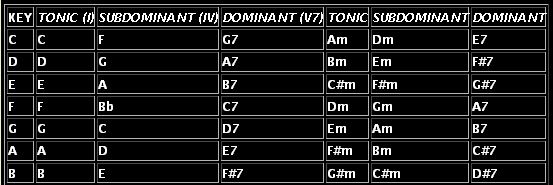
First of all, chords are grouped together in families called “keys”. These chords all relate to each other, which is why they sound good together! If you sit down and look at the chords to a lot of popular songs, you’ll notice that very often the same chords will be together in different songs. If you see a song with a “G” in it, you’ll often also see a “C” and/or a “D” too.

Below, I’ve listed some keys, and all of their relative chords. If you play these chords together, you’ll notice that they all sound like they work together…voila!

Chord Keys
Chord Keys

So that’ll give you a few chords to work with. But of course there are MANY, MANY more different types of chords! Not only that, but you don’t HAVE to use chords in the same key…experiment by throwing a chord in a different key in somewhere…that’ll give a little musical twist to a song! Nirvana was a band notorious for writing songs with chords that were in different keys…it gave a kind of strange mood to some of their material that was part of their ‘sound’. What’s your sound going to be? 🙂

Reblog this post [with Zemanta]

The Second Verse – How to Write the *%&!@ Thing!

© I.Woloshen

Why is it that the hardest part of a lyric to write is so often the second verse? Ever had this problem? It’s almost as if you’ve already said it all in the first verse…so where do you go from there?

There are several schools of thought on this one…I’ll tell you mine! First of all, maybe you HAVE said it all in the first verse. Some stories are shorter than others, some jokes get to the punchline faster. But don’t give up yet! There are certainly some things you might try before scrunching up that paper and filing it under “G”. And instead of telling you “don’ts”, I’m going to try to keep it all in the “do” category 🙂

1. Here’s one idea: do you remember having to write an essay in school, or maybe an article? One of the things your teacher might have told you to do was to try the “5 W’s”…who, what, when, where, why. If you haven’t covered all of these in your first verse, that may help you to expand upon your lyric in the second.

2. Refer to your chorus (if you have one)! The chorus is supposed to be the whole point of the song…use that main theme to get more ideas about where to go with the rest of the song. Verses work well if they all relate somehow to each other, and all to the chorus. I call these threads because of the idea of all of the verses “tying” together. The chorus can sometimes give you a clue as to how to expand upon your first verse and tie that in with your second.

3. Think of using a timeline, past, present and future. This may actually change the verse you already have a little…maybe you need to adjust it to be in the past tense. Tenses have to be used carefully, you can’t move all over the place in time without confusing the listener somewhat…so use with caution!

4. How about this? Make your first verse your second! Then write another first verse 🙂 The point is that sometimes it’s just a psychological rut you’ve gotten yourself into, and moving the first verse to another position might get you out of it.

5. Ultimately, maybe you have nothing more to say. Maybe there isn’t enough of an idea for a song lyric. It’s not inconceivable to just dump what you have and start on another track! Again, it’s possible that you’ve just got yourself into a lyrical rut and starting fresh might help.

Yes, for some reason, it always seems to be that second verse that trips us up. Remember the old song “Henry the 8th”? After the first verse, he yells “second verse, same as the first!” Well, you don’t have to resort to that just yet 🙂 Getting another objective opinion might also help…read to someone what you have so far and ask them what it makes them think. You might have to give them a songwriting credit, but if it means finishing the *&#$/!! thing, well, why not? Good luck!

Reblog this post [with Zemanta]

Self-Indulgence – Don’t Sound Like A Beginner!

© I.Woloshen

Just to qualify what I’m about to say here: this applies to songwriters who are either performing or trying to pitch their songs, not necessarily to hobbyists!

After having listened to many, many songs, and critiquing lots of lyrics over the years, I can spot a “beginner” almost immediately! Don’t misunderstand, there is nothing BAD about beginner songwriters…we all have to start somewhere! As I’ve said before, it takes about 50 songs before you begin to find your songwriting “voice”, your individual style and content. But some songwriters take 100 songs to get there, and some never get there. Why? Well, it’s simple. It’s difficult to step outside of yourself and hear your song from another person’s point of view. And THAT is the whole key to writing songs that you want others to hear and love. Right?

What I’m going to discuss here ideally shouldn’t be implemented until AFTER your first draft…that’s because if you think too hard too soon, you’ll lose the connection with your creative self, and we can’t have that! So consider what I’m about to say once you’ve got the first version of your song in front of you.

The very first hurdle we have to overcome as writers is self-indulgence. Although “self” expression is probably why we started writing in the first place, it doesn’t have much weight when it comes to getting your material across to your listeners. Why do they want to hear all about you and your problems? You know what I mean? Self-indulgence happens when we get so enamoured with a chord, or a line, the sound of a note or a repetitive phrase, that we can’t let it go. This is “no-no” number one. The second no-no is when a song meanders on and on without any seeming purpose. It is NOT EASY spotting your own self-indulgence however! Here are some things to consider:

Repetition – I refer to this later in another article, but here is where I want you to understand the difference between “good” repetition, and “bad”. Popular music especially relies on a certain amount of repetition in order for the listener to remember! Rhyme helps too, but a “hook” or repeating line or musical phrase creates the memorable part of the song that brings a listener back for more. But how much do you repeat? Just enough and not too much 🙂 I once had a writer send me lyrics in which EVERY LINE ended with the same word! It’s not hard to see how this would create a yawn in no time! That is an extreme example, but I understood that he thought he was reinforcing his theme and how can you ever do too much of that? Well, you sure can.

Lyrically, I try to stick to the “three’s plenty” rule. If I want to use a word or phrase as a hook, if you will, I won’t repeat it more than three times in a chorus, for instance. If I had a four line chorus, the fourth line would be the “twist” or the surprise, or something different. But the shorter the lines, the less likely I’m going to repeat too soon!

(I want to make one destinction here…there is a difference between repeating a word that is IMPORTANT to the song [like the hook] and a word that is repeated in error! Sometimes I find that when I’m first writing, I use the same word twice in a verse or song without realizing it and when I get to the second draft or beyond, I’ll usually replace one of them.)

Musically I use the same rule. It is rare that I will repeat a musical phrase or melody more than three times within a verse or chorus. Here’s an exersize you can do to reinforce this idea. Sit down and sing the same short line four or more times. Try to pay attention to when it sounds cool, and when it gets tedious. Again, the length of the line has a lot to do with when that happens!

Meandering – this is almost the opposite of repetition! Some songs can go on and on and on and never get anywhere! Imagine listening to a long and boring monologue, no jokes, no purpose, just a continuous drone. I’ve heard many beginner songwriters write one like that, and I’ve written a few of those myself 🙂 This type of song is in DESPERATE need of repetition. You might be afraid to repeat too much and end up going in the opposite direction. Sit down with your song and plot out how long it takes you to repeat a musical phrase. So much of this is intinctual, so I can’t tell you you need to repeat every 10.5 seconds, but you HAVE to learn to listen to your own songs with some objectivity. If you have really long verses, think about repeating musical lines within that verse, don’t make the whole verse one long musical line. Does this make sense? If your verse is relatively short, there isn’t as much need for repetition, is there? Because you’re going to move on to the next verse more quickly! A repeated chorus can also satisfy this need for repetition somewhat. If your song doesn’t have a chorus, you still need SOMETHING that a listener can hang on to. A refrain will do that job…think about Bob Dylan’s song “The Times They Are A Changin'”. That line is the refrain…he doesn’t have a “chorus” in the song, just verses with that line at the end of each one.

Lyrically, meandering can be a little different. Sometimes a songwriter will send me a lyric that starts out with an idea in the first verse, and then moves onto another unrelated idea in the next verse, and another one…there is very little that ties these ideas all together. I find myself telling songwriters to “focus” a lot! Focus in on what your song’s lyrical purpose is. Plotting out a kind of storyline helps you to focus…write out a phrase that represents each verse and chorus, like this:

Verse 1
I just don’t want to see you anymore

Verse 2
What happened to the way things were?

Chorus
There’s nothing left of us

So I’m plotting out where I’m going with this song without getting tangled up in rhymes and meter and all of that, stripping it down to it’s main purpose.

A listener is almost ALWAYS waiting for the repeated part. If you make them wait too long, you’ve lost them. If you never get there, you bore them. There are simple listeners and sophisticated ones…you won’t please all of them, but your job is to decide who you are writing for and figure out how to leave them wanting more!

Reblog this post [with Zemanta]

Dynamics and Tension: What They Are and How To Use Them

© I.Woloshen

Having spent many years listening to and reviewing other songwriter’s songs, and working on my own, I am struck by a number of recurring problems that songwriters have. The obvious ones, like a low quality recording or not having a great singing voice, aren’t the only problems. What seems to be an affliction of many of the songs is that they lack dynamics and tension.

What exactly are dynamics in songwriting? Simply speaking, they are contrasting parts. For example…if you write a song with the chord progression and/or the melody the same in both the verses and chorus, you risk having a pretty dull sounding song. That is not to say that it hasn’t been done effectively, but this is just one example that I came across while reviewing songs. By putting a little contrast in different places, your song will stand out!

What exactly do I mean by “contrast”? All I’m really talking about is change…you can create contrast by having a different melody in the chorus than in the verses. When it comes to melody, you can also create these dynamics within a verse. For instance, maybe the melody starts out in a lower register (lower notes) at the beginning of the verse, but gets higher as the verse progresses. Or, you can change chord progressions within a verse toward the same end. So, for example, the first line might contain 2 bars of G followed by two bars of C. Maybe the next line is the same. But the third line could begin with a D and so on, just to create that contrast. But it doesn’t stop there! Dynamics and contrast can also be achieved lyrically…the mood or emotion can change from verse to verse or verse to chorus. As an example, the song might start out with the main character walking into an empty bedroom and feeling low because his lover has left him…the next verse might be him reminiscing about their relationship, about what they had and lost…and then the chorus could be filled with his anger at being jilted. Do you hear it? I mean, just by reading those words, can you almost hear what the music would be like? Interesting 🙂 That’s the natural dynamic of the story, almost begging you to put the right chords and melody to it!

Dynamics and contrast can also be achieved within the meter of a song (the rhythm of the words). As an example, in one of my songs, Let’s Make Trouble:

“He said ‘Damn! If you don’t look good tonight
……………………………………….
You’re a little bit of trouble and it’s just not right.’
……………………………………….”
But with a wink of her eye, he forgot what he said
Thoughts on fire and a body hell bent”
……………………………………….
……………………………………….

(“Let’s Make Trouble” Copyright © 2000 I. Woloshen SOCAN)

So what I’ve done in the example above (without actually showing you the music) is to show you how the lyrics work within the verse. There is a line of lyric, then just an instrumental line, then another line of lyric. THEN, I do two lines of lyric in a row, followed by two instrumental lines in a row. So the feel of the first half of the verse is more spacey, but the two lines in a row create a kind of build, feeling like I’m singing faster, and then there’s the release of the two instrumental lines. (If you’re interesting in actually hearing it, you can listen to Let’s Make Trouble on my Soundclick page. Scan down the page to find it…) So a dynamic is created within this verse by having the first half different from the second half. The length of lines can also be a contrast. In a verse of a song, you might have a long first line and a shorter second one, etc. You could also have, in a 4 line verse, three shorter lines and then a long 4th line. If you make everything exactly the same and don’t build in a few contrasts, there is no dynamic, and the song can sound pretty dull pretty quick!

Tension is another aspect that is often lacking in a lot of the songs I hear. Quite often, you’ll find choruses have a higher range of notes than the verses in order to create a dynamic effect. So there’s the “contrast” we spoke of earlier. But this kind of build up to the chorus does something else: it creates tension. Let’s put it this way. If you hold a rubber band loosely, and then slowly start to pull both ends of it, this would be what the verse is trying to accomplish…you pull and pull…then SNAP!! The chorus is the release of the rubber band…the release of tension. The next verse creates that kind of build again up to the chorus and the whole process repeats. But tension can also be created lyrically…think of a standup comic telling a story. He’s setting the stage, telling the story just right so that when he gets to the punchline or the payoff, you’ll howl with laughter! And then he might go onto another related story, occasionally referring back to the first one. He’s manipulating your emotions, playing you in order to get his laughs exactly where he wants them. And just like the comic, timing is another factor in songwriting, where you sing and where you leave a space can really produce an effect or leave an audience flat. Building up to something and then not delivering can be a disaster! You’ll never get a slot at Yuk Yuk’s again!

A great songwriter knows how to time everything…it can be done with humour, with anger, with any type of emotion…for example, expressing a deep longing and make you feel it too in exactly the right place and at the right time. A great movie maker can do the same thing. In fact, I think songs are very much like stories and movies…all stuffed into 3 or 4 minutes!

One other note: these effects…dynamics, contrast and tension…are also often achieved in the production of a song when it comes to the recording process. Different parts of a song can be supported by different instruments, a build of instrumentation, softer or heavier, louder or quiet. But if a song has all of these elements to begin with, you don’t have to rely on creating it in the studio! The best songs can be sung with one voice and one instrument creating that wonderful array of dynamics, contrast, tension and release without any need for anything else!

Reblog this post [with Zemanta]