Results of My Survey

© I.Woloshen

For the past several months, I have had a survey up on my main songwriting tips page with some basic questions on your experience, preferences, goals and others. The survey brought some surprising results, at least to me! What I want to do here is go through the questions and responses and evaluate them! The company that provided the poll changed around and as a result, the poll is no longer valid. However, I’ll be creating new polls in future so stay tuned! As for the results I received from the last one, here are the results:

The length of time most of you have been writing surprised me a little. I usually hear from people who have only been writing for a short period of time…but according to the survey, MOST of you (36%) have been writing longer than 10 years, followed by 2-5 years (32%), less than one year (19%) and 5-10 years (13%). What is interesting to me is that although I started 32 years ago, I realize that it is only the last 10 years that counts to me. Why? Because I don’t think I really studied the craft until then. Before that, I could have cared less to do any rewriting or to step outside of myself and think about what an audience response to my song would be. So I’ve come to the conclusion that the length of time we’ve been writing is probably not all that relevant! Have we spent that amount of time REALLY studying songwriting? I have read some great lyrics by people who have only been writing for a short while…and some equally weak lyrics from some who’ve been at it for some time!

Most of you who responded write both lyrics and music (67%), more write just lyrics (25%) than just music (8%). This was a newer question on the survey and therefore has fewer responses than some of the others, but seems to confirm my suspicion that MOST songwriters aim to do both.

The majority of you are what I call “sporadic” writers (42%)…I include myself in that category. I can go a long time without writing, and then suddenly spew out a long list of songs. This is why I don’t believe in “writers’ block”, at least for me! Because there’s a time that I’m in the songwriting “mode” and a time I’m not…sometimes I have nothing to express! 25% of you write daily! I wonder if you have written daily for all of your songwriting life? My guess is that there are probably some who responded this way because you THINK you should write daily 🙂 25% write weekly. This seems fairly reasonable. 8% of you write monthly.

The next question is one I took particular interest in…”What do you feel is your biggest weakness in your songwriting?” My guess would have been lyrics, since the majority of songwriters I hear from seem to find difficulty in coming up with fresh and original lyrics. But most of you (24%) responded that “structure” was your biggest weakness! I’m wondering if this is because the definition of structure isn’t all that clear? What I call ‘structure’ is also defined in songwriting terms as ‘form’. This is the ABABCB (or any combination of those) that you always hear about, where A=verse, B=chorus and C=bridge. There does seem to be some confusion by newer writers about what a “bridge” is, or a “pre-chorus”, and where they belong. But considering that most of you have been writing for more than 10 years, the confusion about structure does come as a surprise! 19% find melodies the biggest challenge and the same number say that “conveying a message” is their biggest weakness. I DID say to pick more than one if necessary, so the demo may be a little skewed by that. Another big surprise…only 1% of you said that uniqueness is your biggest weakness…now that’s a shock! For the most part, many of the songs I listen to or lyrics I read from newer writers really lack the uniqueness quality! Nobody thought rhyming was their biggest problem…this is also very interesting. Is that because it’s easy to rhyme words, or because you practise rhyming more than anything else? 🙂 14% thought your lyrics were your biggest weakness, and 10% music.

None of you have successfully found a songwriting collaborator on the internet. Whether that’s because you aren’t looking for one, or just haven’t had any luck, is another question. Considering that the internet has become a great tool for interacting with other songwriters, this also comes as a surprise to me!

The majority of you are interested in seeing more articles on lyrics (27%) or just more of anything (27%). Articles on performing (14%) and music (16%) and the business (16%) are pretty even. I do take this question pretty seriously…but it is curious to me in comparison to the question above about your biggest weakness, where only 14% of you thought it was your lyrics. I also like the fact that a good number of you will leave the choice of article topics up to me 🙂

In terms of songwriting goals, I’m also very fascinated to know that most of you (41%) are interested in becoming a performing songwriter! Practically speaking, it IS an easier way (if you can say that!) to get your songs heard by others. The trend in major music centers like Nashville these days is for a songwriter to be self-contained. In other words, less and less signed artists look outside for material and more write their own. 36% of you are in search of a publishing deal, 14% write purely for fun, and 9% haven’t quite made up their minds what they’d like to do yet.

The majority of you (86%) have never attended a songwriting workshop put on by a songwriting organization! I enthusiastically encourage you to do so! Not only is it a great learning experience, but you will finally meet more of your own “kind” 🙂 A lot of success in the music business, for instance, is based upon who you know. You’ve heard that one before, haven’t you? But who’s going to know you if you don’t get out there and introduce yourself? That’s the biggest side benefit from attending workshops, aside from honing your songwriting skills. Okay, enough preaching 🙂

And last, but certainly not least…favourite songwriting tools! I told you you could pick more than one, of course. Looks like the good ol’ “pencil and paper” method of writing is still valid one (36%), followed by the guitar (24%), micro cassette recorder (11%), keyboard (9%), newspapers/books/magazines (7%), the Internet (7%) and a rhyming dictionary (4%). I didn’t include a thesaurus, which I use all the time, don’t know why I forgot that.

As I said earlier, the poll no longer works, but I will be creating more in future, so stay tuned 🙂

Reblog this post [with Zemanta]

Vowels and Consonants and Syllables – Oh My!

© I.Woloshen

When I was in Grade 7 I remember my teacher, Mr. Fergus, giving us word definition tests every week…I hated them. Words intimidated me for some reason. My vocabulary, I felt, was limited at best, and who the heck needed all of those big words anyway when you could use small ones? I still love the saying “Don’t use a big word when a diminutive one will suffice!”

Most of us understand the K.I.S.S. (keep it simple, stupid) rule when it comes to vocabulary in songwriting. Don’t pop in a fancy word when the rest of the song doesn’t have any. Lyrics seem to be a struggle for a lot of songwriters…they are what I consider to be my weakest element in my songwriting! Why? Well, maybe I still picture myself sitting in Mr. Fergus’ class, dreading the next vocabulary test. As a result, I’ve spent a great deal of time working on my lyrics in the last few years in order to overcome my fear of them. And I’ve learned a few things along the way!

Most importantly, words aren’t just a bunch of letters strung together, they can actually “sing” in a lyric! Some words even sound like the emotion or sound you’re trying to express…”hiss” is one that comes to mind. These words are called “Onomatopoeia“…other examples are clang, pop, ding, wham, splonk, and splat.

You may have heard the term “scan” in a songwriting context. When a line in a song scans well, it has a flow to it, where the sounds of the words, the vowels and consonants all flow together beautifully. A line that scans well is easily sung. One that doesn’t, feels like a tongue twister!

The wrong word in the wrong position can completely blow a line….it can throw the tempo and feel off entirely. A lot of this comes from a songwriter not spending enough time and attention on the lyrics, including misplaced vowels and consonants, and bad placement altogether.

Oh, oh. We’re in English 101 class again 🙂 What is a vowel? Do you remember? A,E,I,O,U and sometimes Y. In the English language you can get two different sounds from each of these vowels, and different sounds from combinations of them. Bonus! And what are consonants? All of the other letters. I’m going to assume you know what a syllable is 🙂 What I want to discuss here is what vowels, consonants and syllables have to do with WHERE you place a word in a lyric and HOW you use it!

Let’s look at any old word…how about the word “it”. The “i” in “it” is a short sound…so an easy rule to remember is “short sound, short note”. For instance, you don’t want to sing the word “it” over a whole note (4 beats). Not only is the “i” in “it” short, but the word has only one syllable. And NOT ONLY THAT, but the word itself is not all that significant. What does that tell you? Don’t put it in a powerful position! For instance, here’s a simple line:

Don’t you know it

If you say this line in conversation, which words would you stress or emphasize? Probably “don’t” and “know”…the “you” and the “it” are not as significant. If you emphasized the phrase this way: don’t YOU know IT…it wouldn’t sound right!

Now look at that line again from another perspective. Which words could you place the longer musical notes under? The same words that are emphasized:

doooonn’t you knoowww it

The word “you” could also have a longer note under it. But the little word “it” will never work that way, certainly not very well! Words that end with a long vowel and no consonant, like “you” or “goodbye” work well at the end of lines, especially if the note at the end of a line is held for any length of time. Words with a hard consonant ending will SOMETIMES work, as in the example “don’t” above. “Don’t” ends with a hard “t”, but because it has a long vowel sound of “o” in it, the word can be sung over a longer note, and the “t” not sounded until the very end of the note. But it can also be sung over a shorter note, with a very quick ending. So let the natural rhythm of your lyrics dictate the flow of your melody…don’t force them into positions where they are uncomfortable!

Now let’s take a look at a verse of a song you probably won’t know, and you try to figure out how the melody might work with it:

Is this goodbye?
Well we haven’t said a thing all day
It’s almost time
So I’m wondering when the dam will break
(“Let It Go” Copyright © 1996 I. Woloshen SOCAN)

Look at the above verse and see if you can figure out the natural rhythm of the words…this, as we’ve said, is called the meter. It could probably be interpreted more than one way!

If you write music and melody first, which is what I usually do, the rhythm and meter of the melody dictates where a long or short vowel might be. Some people find this much more difficult or limiting when it comes to finding words that will “fit” into those notes. When I’m sitting down and creating a melody, sometimes as I’m singing kind of nonsense lyrics, a line or a phrase will pop out that works well with it. Most of the time I have the melody finished before I even starting thinking about lyrics. But I can always mess a little with the melody to accommodate a word or phrase that I really like. It really is very much like a puzzle, except that YOU decide what the end result is going to be and how the pieces will all fit together!

This is really only a brief introduction to vowels and consonants and syllables (oh, my!), and how they work in songwriting. But the next time you sit down to write a melody to your lyrics or fit some lyrics to your melody, pay close attention to the “sound” of the words, not just the sound of your notes!

Reblog this post [with Zemanta]

Chord Keys

© I.Woloshen

Here’s an email I received recently:

“Irene,

If I write a song and start playing the first chord as (A) what other chords can I use that would fit. Usually I go to the C to G type, but that’s because I’m limited. How can I find a wide selection of chords that would that would fit ? especially with minor chords.”

When I first started to learn how to play guitar, every new “neat” chord or progression I learned ended up being in a song 🙂 The more I learned, the more I wrote! So I understand completely the limitations that pop up when you don’t know your instrument all that well. Translation: Learn your instrument!

Here is my simple explanation of very basic chord theory…I hate theory, but it helps to know some of it so you can expand your understanding:

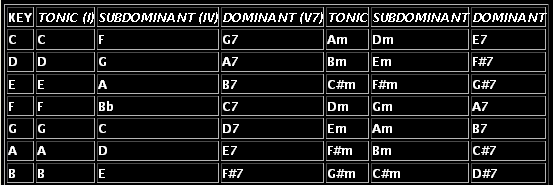
First of all, chords are grouped together in families called “keys”. These chords all relate to each other, which is why they sound good together! If you sit down and look at the chords to a lot of popular songs, you’ll notice that very often the same chords will be together in different songs. If you see a song with a “G” in it, you’ll often also see a “C” and/or a “D” too.

Below, I’ve listed some keys, and all of their relative chords. If you play these chords together, you’ll notice that they all sound like they work together…voila!

Chord Keys
Chord Keys

So that’ll give you a few chords to work with. But of course there are MANY, MANY more different types of chords! Not only that, but you don’t HAVE to use chords in the same key…experiment by throwing a chord in a different key in somewhere…that’ll give a little musical twist to a song! Nirvana was a band notorious for writing songs with chords that were in different keys…it gave a kind of strange mood to some of their material that was part of their ‘sound’. What’s your sound going to be? 🙂

Reblog this post [with Zemanta]

Your Songwriting Career – Taking the Small Steps

© I.Woloshen

One question I get all the time from new songwriters is…”I want to be a hit songwriter (singer, star, etc.) What do I do?” Man! That’s always a HUGE question!

If you decided to climb Mount Everest, would you go there without any plans, without any other thought, and just start climbing? Probably not! But the equivalent of that in songwriting/performing happens ALL THE TIME!! I just met a songwriter who, as an adult, decided to write some songs for the first time, and immediately after getting them demoed went straight to Nashville! It’s admirable, of course, that someone would have SUCH determination so early, but he definitely learned a few things from that experience. Was it a waste of his time? Certainly not, but he realized how far he had to go before he was ready to pitch his songs.

If you’re a hot-blooded songwriter, you have little time or patience for all of the rest of it, all you feel is the fire in your belly to write. You have to spend as much time as you can getting those gems out, but at some point you might start considering how you’re going to get the rest of the world to hear them. Rather than take this from the perspective of an artist or performing songwriter, let’s just consider the songwriter.

There are several ways to get your songs heard. One is to go to an open mic, where you can have the opportunity to play to an audience that doesn’t have a vested interest in you 🙂 Open mics can often be found in the “what’s happening” section of your daily newspaper. Sometimes pubs or bars or even coffeehouse-type venues will hold these events on slow nights just to get something happening. Folk clubs are another place where you might find the opportunity to play. Do some research and find an open mic venue in your area. This might be a HUGE step for some of you, so another “first step” to take is to join a songwriter’s group of some kind.

You can be really grass-roots about it and put up a notice in a local music store looking for other songwriters who might like to get together once in awhile to listen to each others songs. Or you might also consider joining an organization such as NSAI (Nashville Songwriters Assoc. International) or SAC (Songwriters Assoc. of Canada) or any other organization in your area or country, where you will find a good support system and the opportunity to meet and play with other songwriters and even people in the music business. These organizations will go a long way to help educate you and to give you lots of information on the business of music.

An excellent source of information on the music industry is a book called “Songwriters Market” which comes out every year with a fresh crop of names and addresses of publishers, agents, record labels, and lots of useful articles on the subject of songwriting and the music business. Go to your local library or book store and look for a copy. It can also be ordered online from several places…one of my favourites is the Muse’s Muse book ordering page. There are also some excellent books there on the subject of songwriting. I don’t read songwriting books too much, but most of my songwriting pals swear by them…some that are frequently mentioned are “The Craft & Business of Songwriting” by John Braheny, “Tunesmith” by Jimmy Webb, and “Writing Better Lyrics” by Pat Pattison. All can be ordered from the Muse’s Muse.

What is the point of doing all of these things? Why not go straight to a publisher and start pitching your songs? It amazes me how many people start mailing tapes off to publishers BEFORE THEY’RE READY! That’s the point…are your songs ready? You might think they’re perfect (which of course they ARE 🙂 but remember who your competition is! Every great songwriter with a hundred hits already under her/his belt who is still actively pitching their songs…that’s your competition! Can your songs stand up to that?

It’s REALLY important to expose your songs to other people in order to get an understanding of how they stand up. I don’t mean your family, either 🙂 Other songwriters can and will help you with feedback, the organizations I mentioned above will do the same. Don’t jump the gun, take those small steps and you’ll start to build your confidence in your songwriting as you go.

This next point is a sticky one. So let’s say you feel like you have a song or two that you’ve spent a lot of time crafting and it’s ready to be demoed. Do it yourself? Well, before you do, consider a few things. If you’re not a great singer, don’t really know how to use the equipment and have no idea how to create arrangements, you could spend the next 10 years learning…or you could try to find a studio close to you that could do it for you. I know, I know…you’re a do-it-yourself kind of person and how else are you going to learn these things? You’re right, you won’t learn unless you do it yourself, but take it from me, it’s going to be a LONG time before you really learn enough to be able to present your songs adequately. Going into another studio is another way to learn about the recording process, and you’ll meet other musicians and people who are trying to take the same path you are. I DO have an article for beginner recording if you INSIST on doing it yourself! But one thing that songwriters tend to do is to become pretty isolated…meeting other people is also a GREAT way to expose yourself and your music, and create a name for yourself! Okay, so now you’ve got a demo and had some positive feedback…time to send those songs off to the big name artists, right? Yikes! Unless you have some amazing contacts, it just ain’t gonna happen that way. I know, I know, yours is the perfect song for *put BIG NAME ARTIST here*, but how about somebody you can actually talk to at a concert or on the phone? Local artists are ALWAYS looking for material to perform…not only that, but they’re already OUT THERE playing all the time! Do some research, look for some local artists or a band who might be perfect for your song(s). Go to one of their performances, ask them if you can give them a tape. Be prepared. Look professional. Have a business card and mark your tape CLEARLY with all of your contact info. The first artist/group might not go for it…the second one might. Keep taking the small steps.

Now you’re a little further down the road, you’ve been getting your songs demoed, a couple of local acts have been performing them, one group recorded a song of yours…do you know what this is called? It’s called a “track record”! This is your background, your bio, your story. This is when you start pitching your songs to small publishers. The work you’ve done already gives you credibility, it shows you’re hard working and serious and publishers are ALWAYS looking for that! The pitching process is a whole other process, I’ve written another article on it here.

This is what I mean by taking the small steps…if you take enough of them, they will inevitably lead to bigger ones. Don’t run off to Nashville with your first three songs and become disheartened and disillusioned, just take the next step, and the next. And let me know when you get your first cut 🙂

Reblog this post [with Zemanta]

The Second Verse – How to Write the *%&!@ Thing!

© I.Woloshen

Why is it that the hardest part of a lyric to write is so often the second verse? Ever had this problem? It’s almost as if you’ve already said it all in the first verse…so where do you go from there?

There are several schools of thought on this one…I’ll tell you mine! First of all, maybe you HAVE said it all in the first verse. Some stories are shorter than others, some jokes get to the punchline faster. But don’t give up yet! There are certainly some things you might try before scrunching up that paper and filing it under “G”. And instead of telling you “don’ts”, I’m going to try to keep it all in the “do” category 🙂

1. Here’s one idea: do you remember having to write an essay in school, or maybe an article? One of the things your teacher might have told you to do was to try the “5 W’s”…who, what, when, where, why. If you haven’t covered all of these in your first verse, that may help you to expand upon your lyric in the second.

2. Refer to your chorus (if you have one)! The chorus is supposed to be the whole point of the song…use that main theme to get more ideas about where to go with the rest of the song. Verses work well if they all relate somehow to each other, and all to the chorus. I call these threads because of the idea of all of the verses “tying” together. The chorus can sometimes give you a clue as to how to expand upon your first verse and tie that in with your second.

3. Think of using a timeline, past, present and future. This may actually change the verse you already have a little…maybe you need to adjust it to be in the past tense. Tenses have to be used carefully, you can’t move all over the place in time without confusing the listener somewhat…so use with caution!

4. How about this? Make your first verse your second! Then write another first verse 🙂 The point is that sometimes it’s just a psychological rut you’ve gotten yourself into, and moving the first verse to another position might get you out of it.

5. Ultimately, maybe you have nothing more to say. Maybe there isn’t enough of an idea for a song lyric. It’s not inconceivable to just dump what you have and start on another track! Again, it’s possible that you’ve just got yourself into a lyrical rut and starting fresh might help.

Yes, for some reason, it always seems to be that second verse that trips us up. Remember the old song “Henry the 8th”? After the first verse, he yells “second verse, same as the first!” Well, you don’t have to resort to that just yet 🙂 Getting another objective opinion might also help…read to someone what you have so far and ask them what it makes them think. You might have to give them a songwriting credit, but if it means finishing the *&#$/!! thing, well, why not? Good luck!

Reblog this post [with Zemanta]