Performance Anxiety

© I.Woloshen

This will not apply to all songwriters…not everyone who writes also performs, although some writers play their material live to publishers, etc. Performance anxiety is a difficult thing to deal with in that it involves fear, which is completely irrational. I have been struggling with stage fright for many years. People never know I’m nervous, because I’ve become very good at hiding it! For those who don’t perform and don’t understand the feeling, I try and relate it to having to make a speech in front of a whole roomful of people. Then I see the gleam of terror in their eyes!

The only way to deal with fear is to go through it. For a long time, I tried to talk myself out of the feeling, which is futile. The more you resist, the more ominous it becomes and harder to ignore. Alot of what you are experiencing is a physical reaction to a thought. You picture yourself getting up in front of those people and what happens? You get a rush of adrenaline…I feel it especially in the pit of my stomach…then it shoots out all over the rest of my body. Adrenaline does funny things to your body and is associated with the “fight or flight” syndrome which is an ancient part of our physical system. The blood gets thicker, in order to prevent heavy bleeding in the event of an injury. The body becomes numb to pain, going into a kind of shock. The adrenaline does this, as well as making the muscles very energy efficient and extraodinarily strong. You’ve heard of people suddenly being able to pick up cars off of their loved ones? They become superhuman as a result of this syndrome. These days, we also develope the same symptoms in reaction to extreme stress, including stage fright.

The result of all of that adrenaline is usually the shakes. Suddenly fingers can’t find the notes and chords so easily…the voice takes on a strange quiver…the knees seem about to buckle. Another thing that happens to me just before I’m about to perform, is that I start to yawn! People think I’m bored, when what’s really happening is that my body’s attempting to get more oxygen and other gases because I’m not breathing properly.

I’ve gotten some interesting tips over the years that I’ll share with you. They may or may not work, but perhaps the process of thinking through what you’re experiencing will give you some ideas as to how to deal with it.

I try to pack up everything I’m going to need either very early in the day or the night before when I’m thinking straight and will remember everything! The day of my performance I try not to be too active or demand too much of myself. Some may find it better to keep busy and that keeps the mind off of it. However, I find that if I try to avoid the thoughts too much, they get more out of control. I try to nap in the afternoon, even 20 minutes is just enough to give me that extra bit of energy I’ll need later. I also take a long hot bath to relax and soothe myself. I never eat before a performance…the nervous stomach and food just don’t go together. But drinking water or juice is good. Sometimes I’ll have coffee or tea, but not too much. Caffeine and adrenaline is a deadly mix! I never indulge in alcohol before I perform. There’s the false notion that it relaxes you, but I find that ultimately I don’t perform as well. It’s almost as if I do better when I’m in touch with the nervousness!

I get to the place early. This gives me a chance to sit and get used to the room, chat with people and get my things set up. For me, talking to people beforehand also helps me to relax. Sometimes I’ll do this exersize if I’m feeling some tension in my chest: I push the palms of my hands together in front of my chest, hold for about ten seconds, release, and repeat a few times. If I’m more nervous than usual, I’ll walk around abit to release some of it.

There was one time a couple of years ago when I was just getting into performing again after several years away from it. I was so nervous about this first performance that I figured I was going to have to write every word and every chord down because I didn’t think I was going to be able to remember ANYthing! I spoke to an aquaintance who had some interesting advice to give. She told me that some performers when we’re nervous are reacting to old negative thoughts about ourselves…you know, the things our parents or teachers told us when we were young…”don’t be such a showoff”…”behave yourself”…”children should be seen and not heard”. As we get older we start to suppress the natural peformer part of ourselves in reaction to how we are “supposed” to behave in public.

My friend told me that when I feel at the peak of nervousness, to find some quiet place where no one can see me, and GROWL! She told me to EMBRACE that showy, hammy part of myself and say YES! to it. It sounded pretty darn weird to me, but I tried it! Just before the performance, I was literally pacing around the room…I couldn’t sit still or think straight. So I found a back door and peeked outside, and finding no one there, I went out and closed the door behind me and ROARED! Then I had to laugh at what I was doing…and you know, I did one of my best performances that night! What I learned was that I have to forgive myself ahead of time for any mistakes I might make, for any fumbles, and enjoy what I’m doing when I’m doing it. My enjoying it, my laughing at myself or my situation, helps the audience to feel the same way! We click together and I relax enough to do a better job. I read a great line in a book once that said that “fear” and “excitement” are literally the same feeling! It’s our interpretation of it that changes. Now I tell myself that I’m excited instead of terrified…

Reblog this post [with Zemanta]

Song Structure

"This Old Guitar"
Image by Tony the Misfit via Flickr

© I.Woloshen

Often I come across songwriters who are confused as to the labels we have for different parts of a song. Verses and choruses are obvious, I think! However, what is a bridge? A pre-chorus? Intro? Extro? Here are my definitions (I’m smart enough to know that definitions can change from writer to writer!):

A bridge is a musical and/or lyrical break in the song, often inserted after a couple of verses and choruses. It can, when written effectively, give a little change of pace to the song once the repetition begins to become obvious to the listener. Sometimes I might write a simple musical break with no lyrics, usually in the same key, but with a different chord progression. Lyrics are often part of a bridge, however. I’ve also met pro songwriters who HATE bridges and never write ’em! To each his own!

A pre-chorus is a lead up to the chorus, a kind of “build” if you will. They are not as common as bridges, but can be very effective in bridging the verse just before the chorus.

Intros are at the very beginning of a song, the introduction to it. If you are pitching your songs, better keep your intros SHORT!! Publishers, A&R reps and label execs usually don’t have the patience for long self-indulgent intros, and may give up before you even get to the first verse! Sometimes an intro can be effective by foreshadowing the chorus chords just a little, or a quick build of instruments into the song. When I’m playing live, I may stretch the intro to a song and let it build a groove before I start singing.

Extros are often mis-labeled “outros” (I hate that!)…and are the lead-outs or endings to a song. Again, they can get too long and self-indulgent. The faders on recording equipment back in the sixties and seventies lead to just about every recorded song fading out…! There’s nothing that beats a nice, tight and unexpected ending, though!

Middle Eight – this is a term you might hear that sometimes refers to a type of bridge, and other times is simply an instrumental break, usually (but not always) eight bars long. In a rock song, for instance, it might contain a guitar lead…Eddie Van Halen howling alone on his guitar for eight bars 🙂

Breakdown – sometimes about two-thirds of the way through a song, you’ll suddenly hear just the drums playing alone, or the vocals alone, or hand-clapping, etc., with nothing else in the mix. Then, there will be a build-up of instruments again. This is what is referred to as a “breakdown”. It’s more of an arragement term, rather than a songwriting one. But if you’re in a studio trying to get a good recording of your song, you might use this trick to make your arrangement more interesting.

And here’s my extro…. 🙂

Reblog this post [with Zemanta]

Attitude is Everything

Songwriter Session at the Bluebird Cafe: Jamie...
Image by TedRheingold via Flickr, Bluebird Cafe

Even though we songwriters tend to seclude ourselves sometimes when we’re trying to come up with another tune, there does exist a community of songwriters out there. It includes professionals and amateurs, young and old, rock, country, and all of the other genres, and male and female. Each has unique perceptions and experiences to bring to their craft; each is driven by a desire to express and create something.
What I find most interesting is the attitudes expressed and how those attitudes can completely colour my response to a songwriter‘s material. Recently I remember reading a post in the newsgroup rec.music.makers.songwriting from a songwriter who began to list the subject matter that he thought “sucked” in songs. He included any songs you write in the first person, love songs, any kind of relationship songs, and the list went on and on. I was immediately aroused from my complacency, since I most often write about those very topics! It made me think about what it is in a song that appeals to me and what doesn’t, which is a completely relative experience, but I responded with a post saying that it isn’t the subject that “sucks”, but the way in which that subject is handled. What interested me even more was how this person had essentially dismissed the majority of songs and songwriters out there with his attitude. Occasionally the “dark” side of creative immaturity and competitivenss rears its ugly head and reminds me of where I came from.

We’ve all been there. That “I can write better songs than that” string of thought that temporarily boosts our egos when we hear someone else’s material that doesn’t live up to our expectations. It’s too easy to fall into that frame of mind when we’ve had to struggle with our own writing and the self-esteem gauge has dropped below zero. I’ve been to demo critiques in which the “experts” literally devastated the songwriters who were there, and others where the complete opposite has happened.

It’s a tough world sometimes, but the people I’ve admired most are those writers who seem to roll with every punch and have enough energy left to encourage and help others. And the conclusion that I’ve come to, the thought that has helped me more than anything else, is that THERE’S ROOM FOR EVERYBODY! We won’t all make a fortune from writing, or have great recognition, but the talent that exists is extraordinary! Sure, songwriters in the “business” have to compete with others to a certain degree, but it can be done with such graciousness. I’ve heard staff writers talk about sharing writing credits with a person in the room at the time a song was written because that person came up with one line or one phrase. That’s the kind of generosity and maturity we all need to emulate. Time and experience will teach us that, when it comes to the big picture, having written the best or worst song in our lives doesn’t really amount to much, that the value is in the process and in the community we build with each other. You can’t help but be lifted up when you lift somebody else up. These days, instead of trying to figure out what makes a song “suck”, I try to understand what makes it great…if I don’t like a song, rather than getting comparative, I move on to the next one…I take a step back from my ego every now and then and appreciate the process. Songs don’t “suck”…bad attitudes do!

Enhanced by Zemanta

The Music

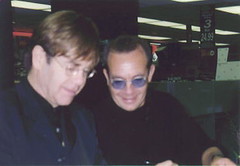
Elton John & Bernie Taupin
Image by Burns! via Flickr

I recently had e-mail from a new, young (14!) songwriter who wanted to know how to come up with the music for her lyrics. Since I usually come from the opposite direction (i.e. I usually come up with music first), it made me think about approaching it from the lyrics first perspective. I sat down and wrote out some lyrics off the top of my head and then realized that I definitely had a rhythm going while I was doing it. Not necessarily a melody, but since I usually write to an established meter with the music already created, I think this brought out my instinct to automatically meter the words.

The difficulty was in developing a melody to them. Elton John is someone who has always taken that role, receiving the lyrics from Bernie Taupin and putting a melody to them. In an interview I saw with him, he discussed how he first reads through the words to get a feel for the “mood” of the song. Sometimes he will change things around (I guess Bernie gives him some artistic license!), making a verse into a chorus or the other way around, adding or changing lines slightly to accomodate what comes to him musically.

Don’t be afraid to let the melody do the “talking”…if the melody starts to write itself a little differently compared to the lyrics, go with it. I heard once that a sculptor looks at the work as already existing within the material…his/her only job is to remove the unwanted stuff. I think you can remove or add lyrics or adjust your meter to make it fit the music and still remain true to the essence of the song.

How to come up with a melody? I once had to write the music to a whole bunch of poems in the play “Through The Looking Glass” (realizing much later that this had already been done professionally!) in high school. This was quite a challenge for me and I worked up quite a sweat doing it! Instead of trying to come up with chords, I “sang” the words…I just repeated them and sung a melody off the top of my head until it developed into something tangible. Then I sat down with the guitar until the chord “sounds” in my head matched the melody. It took alot of patience (when doesn’t it?), and it gave me a whole new outlook into songwriting! Needless to say, I went back to songwriting in my usual way!

Recently a student came to me with a melody she had in her head, but she wasn’t good enough at playing the guitar to play what she “heard” chord-wise. She hummed and I tried all the chords I could come up with and it was pretty frustrating! In the end we still didn’t find it, but she learned more about how to experiment on the guitar until she could come up with it herself!

Coming up with a melody first is my “specialty”. I usually do this by sitting down and experimenting with chord progressions, but sometimes I’m in the strangest places when the thing hits me! Baths are great, so is a walk on a beach for me. Driving the car with no radio or tapedeck playing is good too. What also works for me is learning a new song by someone else…lately Shawn Colvin‘s “Sunny Came Home” has been a source of inspiration…the rhythm of her writing is really catchy and the progressions in that song are terrific. I don’t copy it, of course! But when I learn something new, it often brings out something new because the mood of it can inspire. Or I play it wrong and come up with something else!

There are many schools of thought in terms of writing…my writing is very instinctive and never comes from a “well, this is a ‘C’ so I should be using an ‘Am’ ” attitude. But I have come across a number of songwriters who do exactly that…they come from the theory end of it. In fact alot of serious songwriters study the theory end of music quite voraciously, looking for a clue to writing a ‘hit’. There are all kinds of theories about hit songwriting. For me, I focus first on coming up with something that pleases my ear, and then I worry about whether or not anyone else will like it! Que sera, sera!

Enhanced by Zemanta

Critique and Learn

You may think you’re too new at songwriting to critique…let me tell you a good lesson I learned not that long ago. I had been writing for a number of years, and attended a songwriting workshop where, at one point, we were all supposed to critique each other’s work. Now when I was introduced to some of these writers, I found out exactly how new some of them were to the craft, and I thought to myself, rather ignorantly, how can they possibly help me? I had more “experience”!

As it turned out, they gave me some very valuable ideas, and, most of all, they were able to hear from a totally objective point of view and tell me what DIDN’T MAKE SENSE. You might think you have adequately told your story, until someone comes along and says “How did you get to there from here?” and “What does this mean?”

That’s why I’m a firm believer in critiquing as a way of learning your own craft. What “errors” can you pinpoint in a song? If you just have a feeling about some part of it, can you put it into words, and understand what needs to be corrected?

Most importantly, you will be more open to critiques of your own material! Why? Because you will begin to understand the thought and work that goes into critiquing properly and respect that.

So here are some general rules to critiquing:

  1. “Critique” is defined as critical assessment or evaluation. Anyone can “trash” a song (I’ve heard and read some really bad trash), it’s easy to just say something doesn’t work. Can you say WHY it doesn’t work? That’s where the evaluation comes in.
  2. Look at the song in the same way you would your own. What feels awkward or doesn’t fit?
  3. If possible, give an example of what you might do to change it. This is an excellent exersize in problem-solving for you! Tell them how you did what you did. Sometimes there is not enough time to give examples of everything, but if one seems obvious to you, spell it out.
  4. Never, never say “should”. “You should change this…” implies a hierarchy of some sort and that you know better. Well, if you think you know better, keep it to yourself.
  5. BE SURE to include what you LIKED about a song. It really helps soften up the critiquing you’re about to impart. If you have nothing positive to say about a song, either don’t critique, or spend some good time looking for something.
  6. Remember to take into consideration the style of the writer. A different style may imply a different approach. For instance, some country music works best when the lyrics are conversational but clever. Some progressive rock may imply a less straight up style of lyric-writing. Are there certain styles of music that you loathe? Now there’s a challenge!
  7. The simple things are important. Does the music match the lyric? If there are minor chords, no point in talking too much about what a lovely day it is.
  8. Tell the songwriter that this is JUST YOUR OPINION, and that it must be taken with a grain of salt. They may or may not agree with your assessment. That’s okay! Don’t get your defences up, too! Be humble! Often I’ve had songwriters tell me that someone else said exactly the same thing about the song to them before. This reinforces two things, one is that the songwriter starts to realize that maybe there is a problem if more than one person points it out. The other is that it gives YOU some credibility!

I think there’s alot to say about critiquing, and I may just add some things as I think of them. In the meantime, try it out! See how much YOU learn!

Reblog this post [with Zemanta]