post

A Tribute To Our Trees

When I first moved to Victoria many years ago, among the first things I noticed were these unusual looking trees in my neighbourhood. Well, unusual to me, maybe because of the sheer number of them, but also because of their looks.

They had gnarly, crooked branches, a unique greyish bark, and they were everywhere. I soon learned that these trees were called Garry Oaks. They are apparently found as far south as California, but Garry Oaks were named after Nicholas Garry, the Deputy Governor of the Hudson’s Bay Company. I didn’t know that until just now.

I also didn’t know that Oak Bay was named after the Garry Oak tree. Duh. But then when I learned that my neighbourhood is called Oaklands, it made perfect sense to me. Garry Oaks are all around us.

We live on a corner lot, and there used to be three or four of them on the street corner right beside our house. On a blustery winter day about twenty years ago, one of them crashed down, first hitting our chimney, knocking a part of it loose, and then coming to rest on the back of my husband’s car.

We called the city and when they investigated, they found that particular grove of trees had some kind of rotting root fungus, meaning the rest of them were a hazard to leave there. So, sadly, they all had to be taken down.

But, as they say, the apple (or in this case, the acorn) doesn’t fall far from the tree. Another Garry Oak is now growing in the same spot and is thriving. I’ve made it a part of my little garden there. And we still have a grove of mature Garry Oaks by our back yard.

Right now, trees of every sort are top of mind as communities all over the northern hemisphere deal with high heat, droughts and as a result, forest fires. It’s terrifying.

When fires are caused by lightening or other natural events, that’s bad enough. But why is it that some idiot humans HAVE to have their campfires flaring or absently flick their cigarettes into the bushes? As joke goes, what’s worse, their ignorance or their apathy? (Answer: They don’t know and they don’t care).

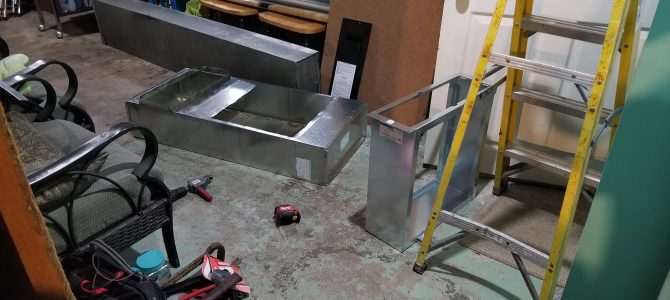
The Garry Oak is supposed to be drought tolerant, but lately they’ve been getting a little help from the city, as you can see in the photo above. Portable water tanks have been popping up around my neighbourhood and in others, giving the trees a little extra hydration. Not just Garry Oaks, other trees too.

On a recent road trip through the interior and the Rockies, I found myself marveling at the numbers and amazing varieties of trees we have all around us…deciduous and coniferous. Do you know the difference? That’s one thing I do know!

And when I walk down particular streets in my neighbourhood, I marvel at the size of the trees lining them. Some of the trunks are massive. It makes me wonder what was going on in the world when they were just seedlings.

Most of the oldest trees in the world are in the US, China and Chile, but a Nootka Cypress tree here on the island is estimated to be about 1,636 years old. That means it came to life at around year 390. The Roman Empire was still going strong then…imagine that!

Trees do some amazing things for us that we often take for granted. Globally, they absorb billions of tonnes of carbon dioxide each year. They even produce small amounts of oxygen. You know, that stuff we breathe?

Besides all of that, what’s more wonderful than lying beneath a gorgeous tree canopy on a hot summer day? Or walking through a local forest like Goldstream Park or Sooke Potholes Provincial Park, just marveling at their magnificence? And that beautiful forest scent…wow.

These days, a lot of airports are creating atriums, outdoor places with trees and plants to give passengers a place to hang out for some stress relief. Ahhh…just relax. Because that’s what trees help us to do.

So before we lose too many more of them, I’d like to raise a glass to our trees, to these natural, beautiful skyscrapers that give our lives so much more than shade. Skál…cheers!

IJ

post

It’s Like Riding A Bike

Remember all of the fuss people made when bike lanes started showing up all over the city, taking over car lanes, or at least impeding upon them? I have to admit, I wasn’t all the pleased to see them myself. And my husband was especially unhappy.

Suddenly you had to pay attention to things like new cycle-only lights and rules about right turns. Not only that, but lots of regular parking spots disappeared. For those of us who’ve been behind the wheel for a long time, it was like driving in a foreign country.

Judging by the comments in local media and online, we were not alone. A lot of people were miffed. And, according to most angry types, including my husband, it was all Mayor Lisa Helps’ fault.

Imagine my surprise then, when my newly retired, anti-bike lane partner pulled out his dusty, rusty old bicycle one day and started pumping up the tires. And, even more surprising, he got right on it and started hobbling down the street. I thought he was nuts.

But he insisted that he wanted to see if he could still do it and I had to admit that I admired his tenacity. He decided he might even like to try an e-bike one day and wondered if I might like to try one too.

Me? On a bike? I wasn’t so sure.

And then something interesting happened. My good friends and I were planning a wine tasting tour in Oliver, and one of the tours was supposed to be on e-bikes. I’d never heard of that before.

So now I felt obligated to pull out my own steed of rusted steel to see if I could manage it.

Holy expletive.

I was pretty shaky at first. It felt familiar, but not familiar enough. Not only that but my once 18-speed bicycle now had only one working gear. Thank goodness the brakes still worked.

For my first ride, I went about 5 blocks and then came right back. The legs were definitely feeling it, and I knew I was going to have to get more comfortable with cycling again before our trip. And after a few short practice rides and only one near spill, I was feeling a little better. A little.

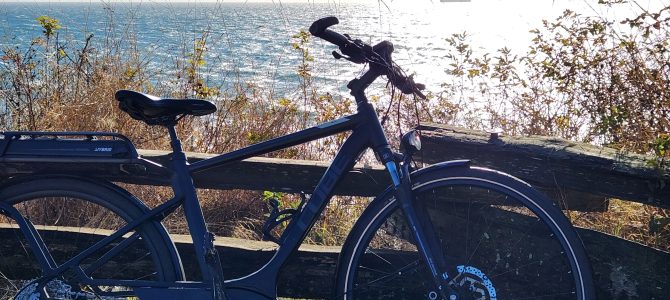
The e-bike was a whole different experience. For those of you who haven’t tried one, I won’t go into all of the technical details. The bikes we rode were German-made CUBEs, and had the usual mechanical gears and then 4 e-gears, going from “eco” to “turbo”.

You can also ride the bike without the e-support, but I’m pretty sure I had it on “eco” for most of our 27 kilometer tour. When the e-gear kicked in, it just felt lighter and smoother. On long stretches uphill, I’d use the “turbo” setting and that helped considerably.

And the wine helped too.

When we got back from our trip, my husband was excited to hear all about it. I have to admit that by then, I was also convinced to get an e-bike of my own.

As it turns out, we found two used ones of the same make, CUBE, on Facebook Marketplace. I guess it was meant to be.

Now it was my husband’s turn to get used to the e-bike, but it didn’t take long. Little by little we ventured further, warming up to the idea of cycling in the city instead of driving.

One day, we went from our house in the Oaklands area all the way to Willows Beach. And on another, we pointed ourselves south and made it through Beacon Hill Park to Dallas Road.

Suddenly we were very grateful for those cycle lanes and signal crosswalks, and the CRD cycle maps. It has become another very different way of experiencing and exploring beautiful Victoria.

We are e-sold. And we’re old enough that we should have learned the old “don’t knock it before you’ve tried it” adage by now.

Apologies, Lisa.
post

We Are Stardust – Following The James Webb Telescope

I sat on the swing set with my best friend Shirley, staring out at the blue, blue sky on a summer day many years ago. We wondered about the stars and the sun and how certain words in our vocabulary came to be. That was the nature of our young friendship – pondering the mysteries of the universe.

Not long after, on July 20th, 1969, I was in Shirley’s living room watching the blurred black and white TV images of Neil Armstrong taking his first step on the moon. “One small step for man…” he began. It was wonderous.

We went outside and tried to find the moon in the day time sky, but couldn’t. Still, we somehow understood that we’d never look at it exactly the same way again, because now we knew human beings had been there. It was forever changed.

I thought about that the other day when I saw the first pictures coming in from the James Webb Telescope on the NASA website. Look how far we’ve come, I thought.

I don’t like saying the word “awesome” too much because it’s overused these days. But those pictures were definitely awesome.

That the James Webb Telescope was even able to blast off was, in itself, a huge feat. Over the years it was being built, there were many cost and scheduling issues. Lots of little things went wrong along the way, and it almost got cancelled completely.

And just imagine the pressure there was to make sure the telescope was as perfect as they could get it before it launched. Because once it was way out there in space, there was no going back.

When it finally left the earth on December 25th, 2021, more than $10 Billion had been spent. And a lot of people were pretty nervous.

Would it get to where it was supposed to go? Would it unfold properly? Would it work at all?

As we saw the other day, it exceeded expectations.

Stephan’s QuintetMany Million Light Years Away

All of the pictures were spectacular and mesmerizing, but the one that struck me most was Stephan’s Quintet, seen above. First of all, I didn’t realize it, but Stephan’s Quintet is something I’ve seen many times before.

A couple of minutes into the 1946 film “It’s A Wonderful Life”, there is a scene where the angels are praying for George Bailey. The angels are represented by an animation of Stephan’s Quintet, having a conversation.

I never knew that that.

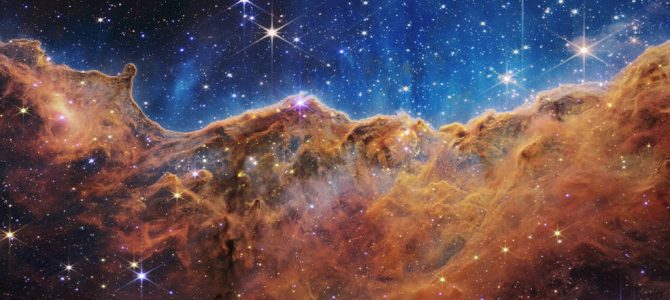
The Carina Nebula photo is also stunning, with sparkling, golden cloud dusts beneath millions of twinkling stars.

The most amazing, mind boggling thing to me is the fact that in those photos, we are looking far into the past. In some cases, we are looking back many millions of light years.

Light years. I’m still trying to wrap my head around that concept.

The telescope’s main mission will last 5 to 10 years, but its expected lifespan will be up to 20 years, similar to the Hubble telescope. Just imagine what scientists, and the rest of us, will learn from it by then.

Maybe we’ll discover all kinds of new things, including ways to help ourselves, and, especially, our tiny blue planet.

As Joni Mitchell sang:

We are stardust, we are golden, and we’ve got to find our way back to the garden.